How Modular Glass Partitions Cut Office Construction Time by 70%

Modular glass partition systems install up to 70% faster than site-built drywall — but the percentage itself tells you nothing useful until you understand where the time actually comes from, and which 30% of the schedule you can’t compress. This guide breaks down the construction timeline week by week, compares three real projects (BMW Brilliance, Longfor Group, Blue Whale SOHO), and shows when modular doesn’t save time.
What “70% Faster” Actually Compares
Construction-industry “X% faster” claims usually compare apples to oranges. Before believing the 70% number for a modular glass partition install, here’s what the comparison actually measures.
The drywall baseline (6 weeks per floor)
A typical office floor of about 800 m² with 12 private offices, 4 meeting rooms, and supporting corridors — installed as conventional drywall partitions — runs roughly this schedule:
- Week 1 — Metal stud framing layout and assembly
- Week 2 — Drywall sheeting both sides, plus insulation infill
- Week 3 — Mud and tape (joint compound), three coats
- Week 4 — Sanding, primer coat, final paint
- Week 5 — Door frame install, glazing, hardware
- Week 6 — Punch list, paint touch-up, electrical and data drop-in
That’s 30 working days on site, with 5-6 different trades sequenced in a critical path. Any delay anywhere pushes the whole schedule.
The modular glass partition timeline (5-10 working days per floor)
Same 800 m² floor, same number of rooms, but specified with our Modular Partition System (either Great Wall visible-frame or Everest hidden-frame series):
- Day 1 — Floor and ceiling track layout, anchor installation
- Day 2-4 — Panel snap-fit assembly (Great Wall) or 3M-bonded sub-frame install (Everest)
- Day 5-7 — Door installation, hardware, EPDM gasket compression
- Day 8-10 — Cable runs through integrated channels, electrical termination, punch list
On-site duration drops from 30 working days to 5-10 — a 67-83% reduction, which rounds to “70%” in marketing copy. The variability depends on door count, custom glass specifications, and how many panels need site-fit (the more standard the spec, the closer to the 5-day end).
Five Sources of the Time Savings
The 70% savings isn’t one big factor — it’s five medium ones that compound. Knowing them helps you predict whether your specific project will hit the savings, or fall short.
1. Factory prefabrication runs parallel to site prep
While your contractor is still doing demolition, MEP rough-in, and ceiling grid work, our factory is cutting, anodizing, and assembling your modular glass partition panels to your specific dimensions. By the time the site is ready for partitions (typically day 30 of fit-out), the panels are already on a truck. Site duration and factory lead time overlap completely. Drywall can’t do this — every step happens sequentially on site.
2. Dry assembly only — no wet trades
A drywall partition needs three wet trades: joint compound (mud), primer, and paint. Each requires drying time (4-24 hours per coat) before the next trade can work. A modular glass partition has zero wet trades. The system arrives, snaps together, and is finished. No drying. No cure-time gating.
3. No structural curing time
Even our Everest hidden-frame series uses 3M VHB structural acrylic adhesive, which reaches handling strength in 20 minutes and full cure in 72 hours — and only the panel-to-frame bond requires it, not the full wall. Great Wall has zero adhesive cure time (EPDM rubber gasket is mechanical compression). Drywall mud needs 24 hours per coat × 3 coats = 72 hours of pure cure time before paint can begin.
4. Cable and data run inside the partition, not behind it
Drywall partitions hide cables in the stud bays. Adding or moving a network drop requires opening the wall, fishing the cable, patching, sanding, and repainting. Modular glass partitions integrate 105mm or 178mm cable channels inside the wall thickness — the cable runs in a serviceable raceway accessible from end caps. No demolition, no patch, no paint. This isn’t just an install-time saving; it’s a 5-year operational saving on every cable move.
5. Same crew across multiple floors — no learning curve
Drywall crews vary in skill and finish quality. Two different teams produce two visibly different walls. Modular partition installation is a repeatable mechanical assembly — same panel, same snap-fit, same gasket, every time. A two-person crew that installs the first floor in 8 days installs the second floor in 6, and the third in 5. Across a multi-floor project, that compounding speeds the whole job 20-30% beyond the baseline savings.
Real Timelines from 3 Projects
The 70% figure is an industry-typical average. Here are three real modular glass partition projects from our reference list, with actual install duration data.
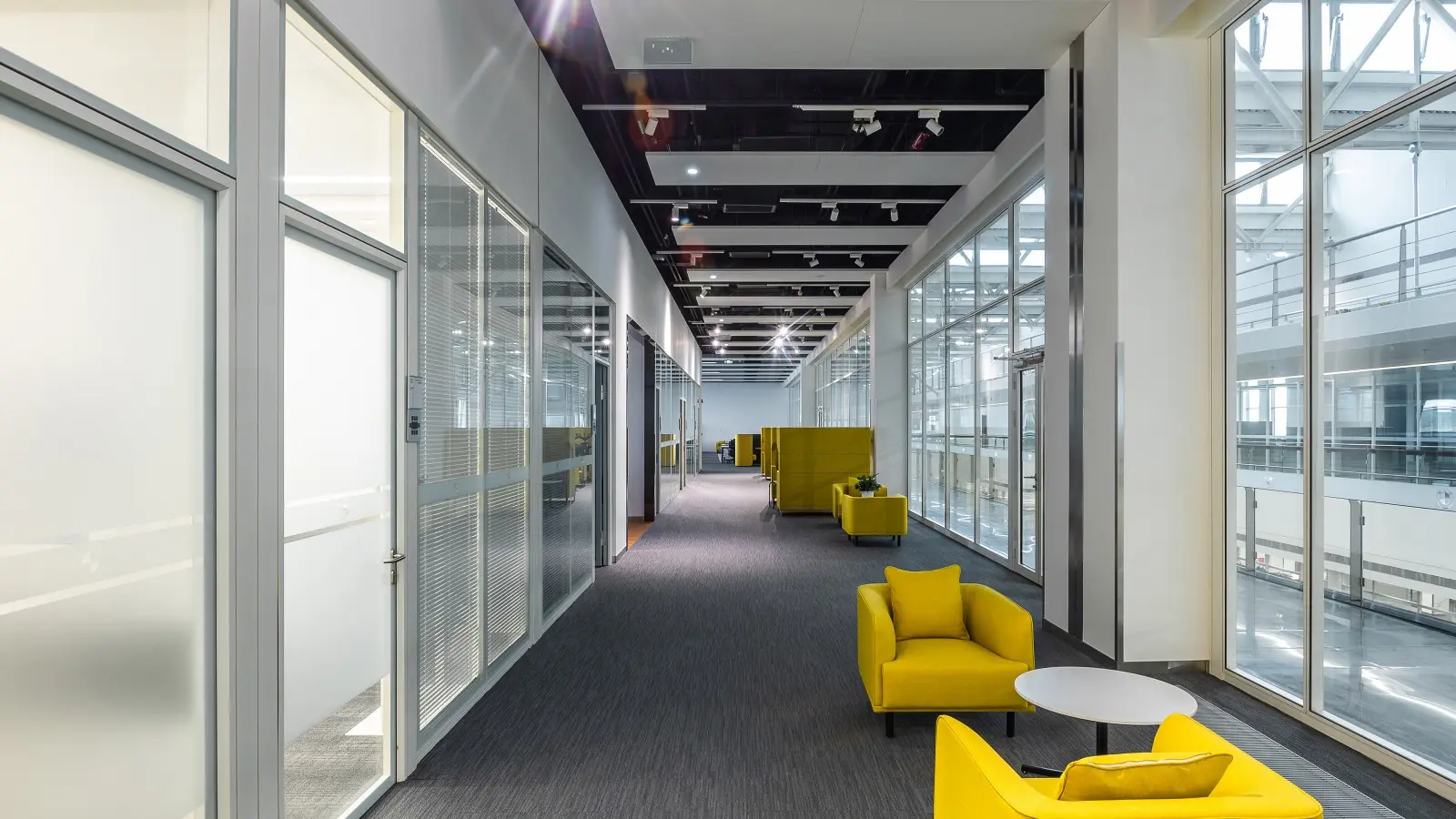
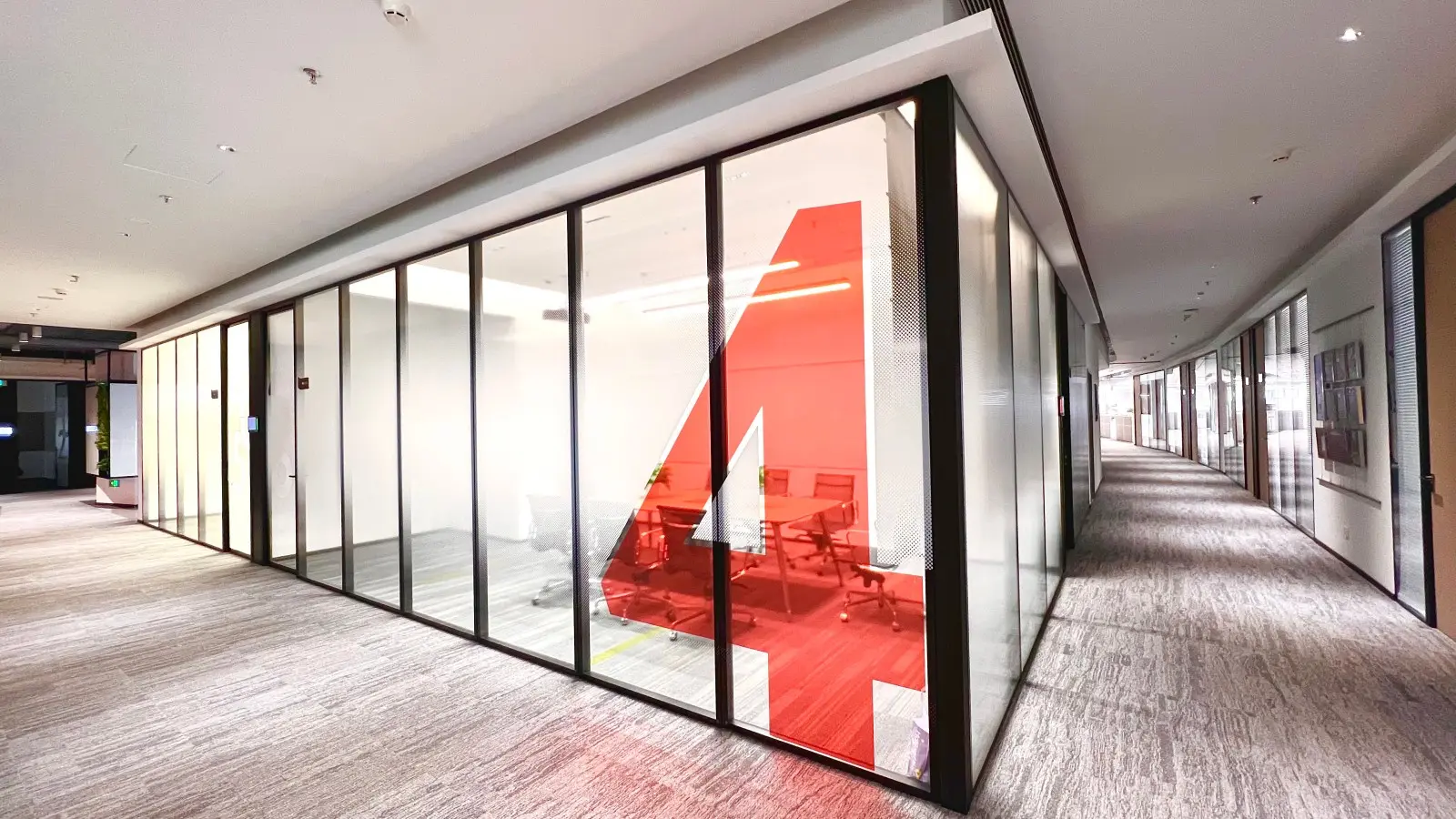
Project 3: Blue Whale SOHO Coworking — multi-floor coworking with industrial-style aluminum framed partitions and solid panel brand walls. ~2,000 m² across 2 floors. Install duration: 12 working days. Drywall equivalent: ~50 days. Time saved: 76%.
Across these three projects the average time savings is 76% — slightly above the marketed 70%. The variation between projects (75-77%) suggests the savings are predictable once a project is above the 30 m² minimum threshold.
The Hidden ROI: 95% Material Reuse
Install-time savings are visible at handover. The bigger return shows up 3-5 years later, when the office reconfigures.
A drywall partition that’s moved means: demolish the wall (1 day), haul debris (0.5 day), rebuild stud framing in new location (1 day), drywall, mud, tape, paint (2 weeks). Same six weeks of trades, this time with the added cost of waste disposal. The original drywall, mud, and paint go to landfill — 0% material reuse.
A modular glass partition reconfiguration means: unsnap the panel from the gasket (or de-bond from 3M tape, slightly more involved on Everest), pull the panel down, relocate it, snap into a new track location. Same panel, same glass, same hardware. Material reuse rate: 95% — the only loss is the gasket and a few fasteners. The new install takes 30-50% of the original install time because the panels and frames are already on site.
For projects pursuing LEED certification, this directly contributes to material reuse credits (MR Credit: Construction and Demolition Waste Management, plus Building Product Disclosure and Optimization credits). A site-built drywall partition cannot earn these credits — it’s by definition single-use construction.
The 5-year math
Assume a 3,000 m² office that reconfigures 30% of its layout every 18 months — typical for tech, coworking, and growing startups. Over 5 years that’s three reconfigurations affecting 2,700 m² of partition total.
- Drywall path: 2,700 m² × ~$110/m² rebuild cost × 3 cycles + landfill fees ≈ $310,000 over 5 years
- Modular path: Reuse 95% of panels, only relabel + new gaskets + hardware ≈ $45,000 over 5 years
The modular system pays back its initial premium (typically 20-40% higher capex than drywall) inside the first reconfiguration cycle — and starts generating net savings from there.
When Modular Doesn’t Save Time
This article would be useless if we only listed the wins. Here are the four scenarios where the modular glass partition time advantage shrinks or disappears entirely.
1. Projects under ~30 m² of partition
The 4-6 week drywall baseline includes a lot of trade mobilization, layout, and finishing time that doesn’t scale linearly with size. For a small project — say one private office, 12 m² of partition — a drywall crew can finish in 4-5 days. Modular still needs the factory production lead time (22-30 days), which doesn’t compress for a small order. For very small jobs, modular is slower than drywall.
2. Highly custom curved or non-standard geometries
Standard modular runs use standard 600/900/1200 mm panel widths. Custom curves (like the polygonal frameless meeting pods at Ai-Working Coworking Space) require custom-cut glass, custom radius framing, and on-site fitting — adding 3-5 days to the install. Still typically faster than drywall, but the gap shrinks from 70% to maybe 50%.
3. Sites with restricted hours or weekend-only access
Modular installs benefit from continuous 8-hour work days. Sites that allow only after-hours work (occupied buildings, hotels mid-operation, retail spaces during business hours) stretch a 7-day install to 14-21 evenings. The advantage over drywall is still there but smaller in calendar terms.
4. The first time a contractor installs your specific system
The 30-50% second-floor speedup we mentioned earlier is real — but it works the other way too. A contractor’s first modular install will run 20-30% longer than the schedule allows for. If your project is one floor only and the contractor hasn’t installed your system before, factor in a learning premium and don’t promise the absolute fastest timeline.
Frequently Asked Questions
What’s the typical factory lead time for a modular glass partition order?
25-30 working days from approved shop drawings to ship-ready for standard configurations (Great Wall single/double glass, Everest single/double glass, standard RAL finishes). Expedited orders can compress to 18-20 days for projects under 1,500 m² with stock glass thickness and standard finishes. Custom RAL colors, custom paint glass, or quantities over 5,000 m² extend to 30-40 days.
Can modular glass partitions be installed in occupied buildings?
Yes — this is actually one of the strongest use cases. Because the system has zero wet trades (no mud, no paint, no curing time), there’s no air-quality disruption, no dust generation beyond minimal cutting, and no overnight off-gassing concerns. Installs can happen during normal business hours in occupied floors, including healthcare, hospitality, and retail environments where drywall would be impossible.
How does the installation crew size compare?
A drywall partition install needs sequential crews of 4-8 people: layout, framing, hanging, mud/tape, paint, finish carpentry. Total crew-days for an 800 m² floor: ~150-200. A modular glass partition install needs a single 2-3 person crew throughout. Total crew-days for the same floor: ~15-25. The labour cost reduction is even more dramatic than the time reduction.
Are there sustainability certifications that recognize the modular time savings?
Yes. LEED Construction and Demolition Waste Management credit, LEED Material Reuse credit, and WELL Building Standard Air Quality credits all reward modular partition systems either directly (through material reuse rates) or indirectly (through lower jobsite emissions). Our products carry conformance with GB/T 23451-2009 Chinese modular partition standard, plus ISO 9001 quality management and ISO 14001 environmental management.
What’s the warranty difference between drywall and modular partitions?
Drywall partitions are typically warranted only for the workmanship of the install crew (1 year), with no manufacturer warranty on the wall system because it’s not a system — it’s an assembly of commodity materials. Modular glass partitions carry a 5-year structural warranty from the manufacturer (covering glass, frame, hardware, adhesive performance) plus the installer’s workmanship warranty. The longer warranty reflects the engineered system nature of the product.
How does HVAC and ceiling integration work with modular partitions?
Modular glass partitions interface with the suspended ceiling grid through a perimeter track that compresses against the ceiling tile. HVAC penetrations are handled by transferring air through grilles in the ceiling above the partition (the partition doesn’t reach the deck). For full-height applications (partition to underside of deck), our systems include sealing accessories to maintain fire compartmentation. Coordinate with the mechanical drawings during the design stage to avoid clash detection issues at install.
Get a Realistic Timeline for Your Project
Send your floor plan, total partition length, room count, and required move-in date. Our project engineers reply within 24 hours with a project-specific schedule — factory production plus on-site install — broken out week by week so you can sequence the rest of your fit-out around it.