Smart Glass Partition vs Frosted Film: 3 Proven Differences

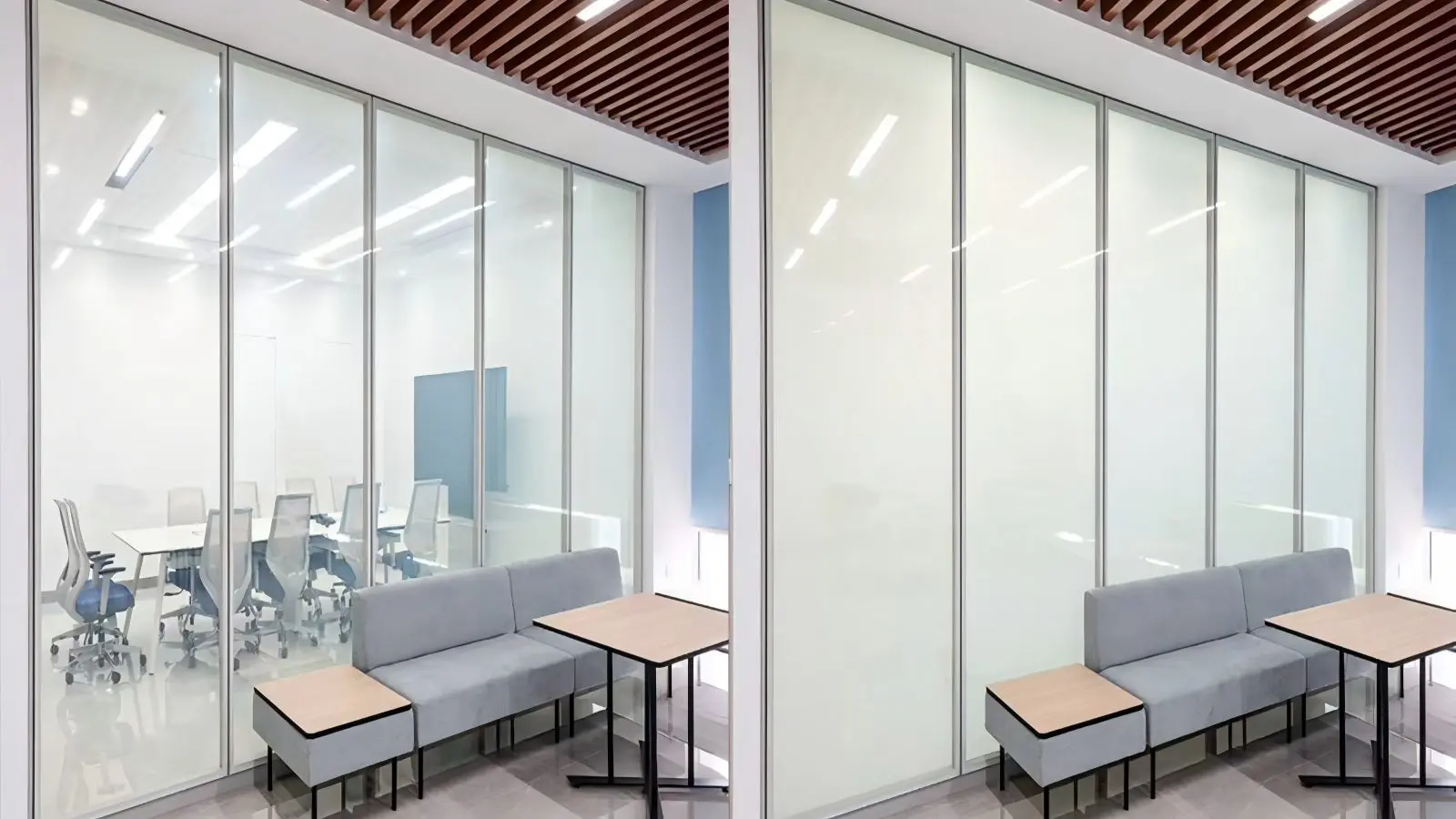
Smart glass partition systems and frosted privacy film solve the same problem from opposite directions — both make glass walls visually private — but at totally different cost, lifetime, and operating logic. This comparison walks through how PDLC switchable smart glass partition technology actually works, where frosted film outperforms it, the real cost difference over a 10-year office lifespan, and how Cushman & Wakefield mixed both in a single floor plate.
The Three Privacy Approaches
Most projects assume there are only two privacy options for glass partitions: install a smart glass partition, or apply frosted film. There are actually three, and conflating them leads to overspecifying — paying for switchable glass when a $25/m² film would have worked, or under-specifying — installing static film in a room that should toggle between privacy modes.
1. Static frosted film (adhesive vinyl)
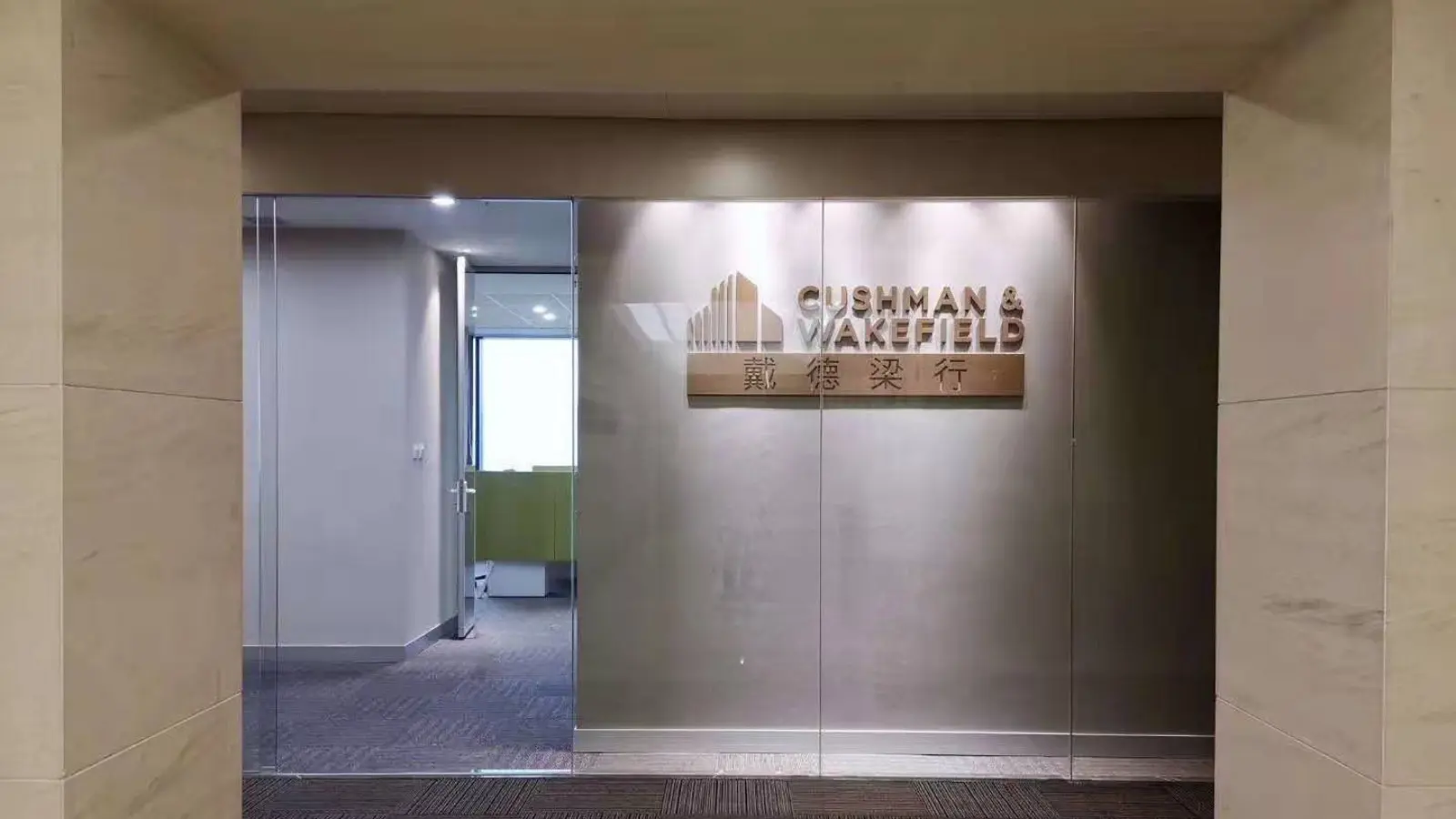
The category most offices default to. Vinyl film — typically from 3M Fasara architectural films or comparable manufacturers — is applied to the room-side glass surface during fit-out. The film is permanently translucent — voices pass through, sight lines are blocked. Branded patterns, logos, or wayfinding graphics can be cut into the film for visual interest. Cost: $25-60 per square meter installed. Lifetime: 5-7 years before edges peel and yellowing becomes visible. Replacement requires careful removal of old adhesive — typically 2-3 hours per panel.
2. Sandblasted or acid-etched glass (permanent factory finish)
The glass surface itself is mechanically abraded (sandblasted) or chemically treated (acid etched) at the factory before installation. The privacy effect is permanent and built into the glass — no film to peel, no replacement cycle. Cost: $80-150 per square meter for the glass premium over clear. Lifetime: matches the partition (15+ years). Disadvantage: the effect is permanent — if the room’s use changes, the partition has to be replaced.
3. PDLC smart glass partition (switchable on demand)
A PDLC (Polymer-Dispersed Liquid Crystal) film is laminated between two glass layers during manufacture. Apply voltage (24V or 48V DC) and the film becomes transparent. Remove voltage and the film returns to opaque-frosted state. Switching happens in under one second. Cost: $400-700 per square meter (8-12× the static film cost). Lifetime: 15-20 years of switching cycles, matched to the partition.
Our Smart Glass partition uses PDLC technology that mounts directly into our Everest hidden-frame and Great Wall visible-frame systems — same modular framing, same install process, just a different infill panel and a 24V DC supply terminated at one end.
How PDLC Smart Glass Actually Works
Understanding the underlying technology helps explain both the cost and the limitations of a smart glass partition.
The active layer is a polymer matrix containing microscopic liquid crystal droplets — typically 4-10 micrometres in diameter. In the unpowered state, the liquid crystals are randomly oriented; light passing through is scattered in all directions, producing the white-translucent frosted appearance. When voltage is applied across two thin conductive films (transparent indium tin oxide layers on either side of the PDLC), the liquid crystals align with the electric field. Light now passes through without scattering, producing transparent clear state.
The whole sandwich — glass / ITO conductor / PDLC / ITO conductor / glass — is laminated under heat and pressure during manufacture, conforming to ISO 12543 laminated glass standard. Power consumption when in transparent mode is about 5-7 watts per square meter; zero power when frosted. The film responds in under one second to voltage changes. Cycling life is typically 100,000+ switch cycles before degradation becomes visible — about 27 years at 10 switches per day.
The US Department of Energy’s Dynamic Windows program classifies PDLC alongside SPD (Suspended Particle Device) and electrochromic technologies as “dynamic glazing” — a category whose primary application has been building envelope glazing but which migrates downward to interior partitions as cost drops.
What can go wrong
Three failure modes specifiers should know about:
- Electrical termination at panel edge — the 24V DC connection enters through a thin metal busbar at the panel’s edge. Vibration or thermal cycling can break this connection. Fix: panel replacement (1-2 hours).
- Power supply failure — if the 24V transformer fails, the panel defaults to opaque-frosted state (safe-fail behavior). Power supplies have separate lifespans from the panel itself (typically 8-10 years).
- Localized PDLC degradation — at panel edges, UV exposure over many years can cause patchy clear/frosted spots. Mostly cosmetic; rarely affects the privacy function.
Side-by-Side Comparison Table
Cost and lifetime numbers normalized to a hypothetical 50 m² conference room with privacy needs on both glass walls:
| Factor | Frosted Film | Etched / Sandblasted Glass | Smart Glass Partition (PDLC) |
|---|---|---|---|
| Initial cost / m² | $25-60 | $80-150 | $400-700 |
| Privacy switching | Permanent only | Permanent only | On-demand <1 second |
| Lifetime | 5-7 years | 15+ years | 15-20 years |
| Replacement labour | 2-3 hours/panel | Not applicable | 1-2 hours/panel if failure |
| Power required | None | None | 24V DC, 5-7 W/m² when clear |
| Brand graphics / decorative pattern | Easy (cut in film) | Easy (factory etched) | Difficult (uniform finish only) |
| Visual continuity in clear mode | Never clear | Never clear | Indistinguishable from clear glass |
| Compatible with our partition framing | Yes (any series) | Yes (any series) | Yes (Everest preferred for cable concealment) |
| Maintenance | Reapplication every 5-7 years | None | Occasional electrical service |
| 50 m² conf room — 10-year TCO | ~$2,800 (1.5 reapplication cycles) | ~$5,500 | ~$22,500 |
The smart glass partition premium looks dramatic in initial cost (8-12× the static film), but compresses to 8× in 10-year TCO once you factor in the film replacement labour and the 5-7 year reapplication cycle. For executive rooms where the value of “switchable on demand” is real, the premium is rarely the deciding factor.
When Each Option Wins
The decision usually settles on a single question: does this room need to switch between transparent and private states regularly?
Smart glass partition wins when:
- The room hosts video calls (need privacy during calls, transparency between)
- Healthcare consultation rooms (HIPAA-grade privacy during consultations, openness between)
- Executive offices that rotate between focused work, meetings, and visiting client display
- Boardrooms with mixed-use scheduling (planning sessions vs sensitive M&A reviews)
- Spaces near reception where the room itself is a display feature when clear, private when occupied
Frosted film wins when:
- The room is permanently private (restrooms, dressing rooms, behind-the-counter retail)
- The privacy treatment doubles as decorative branding (Cushman & Wakefield’s branded entrance below)
- The budget is tight and the value of switching is theoretical only
- The room is hard to wire for 24V DC supply (small remote room far from electrical panel)
- Wayfinding graphics, room numbers, or department branding need to be readable from the corridor
Etched / sandblasted glass wins when:
- The privacy is permanent AND budget allows for the glass premium
- The aesthetic calls for “feels like architectural glass” rather than “feels like film applied to glass”
- Pattern, gradient, or logo treatment needs the depth and quality of actual glass etching
- The project is high-end retail, luxury hospitality, or premium reception where the partition is itself a finish surface
Cushman & Wakefield: A Mixed Approach
A common pattern in modern offices: pick the right privacy solution per room rather than committing to one across the floor. Three privacy approaches in one project — the Cushman & Wakefield corporate real estate office:
Entrance wall: Frosted film with custom-cut C&W brand graphics. Permanent privacy plus brand identity. ~$45/m² installed. Replaceable every 5-7 years when branding refreshes anyway.
M&A advisory rooms (3 rooms): Smart glass partition with motorized switching from a wall panel. Clear state for client tours and casual meetings, frosted state when advisory discussions are in session. ~$580/m² installed. Justified by confidentiality risk reduction during sensitive discussions.
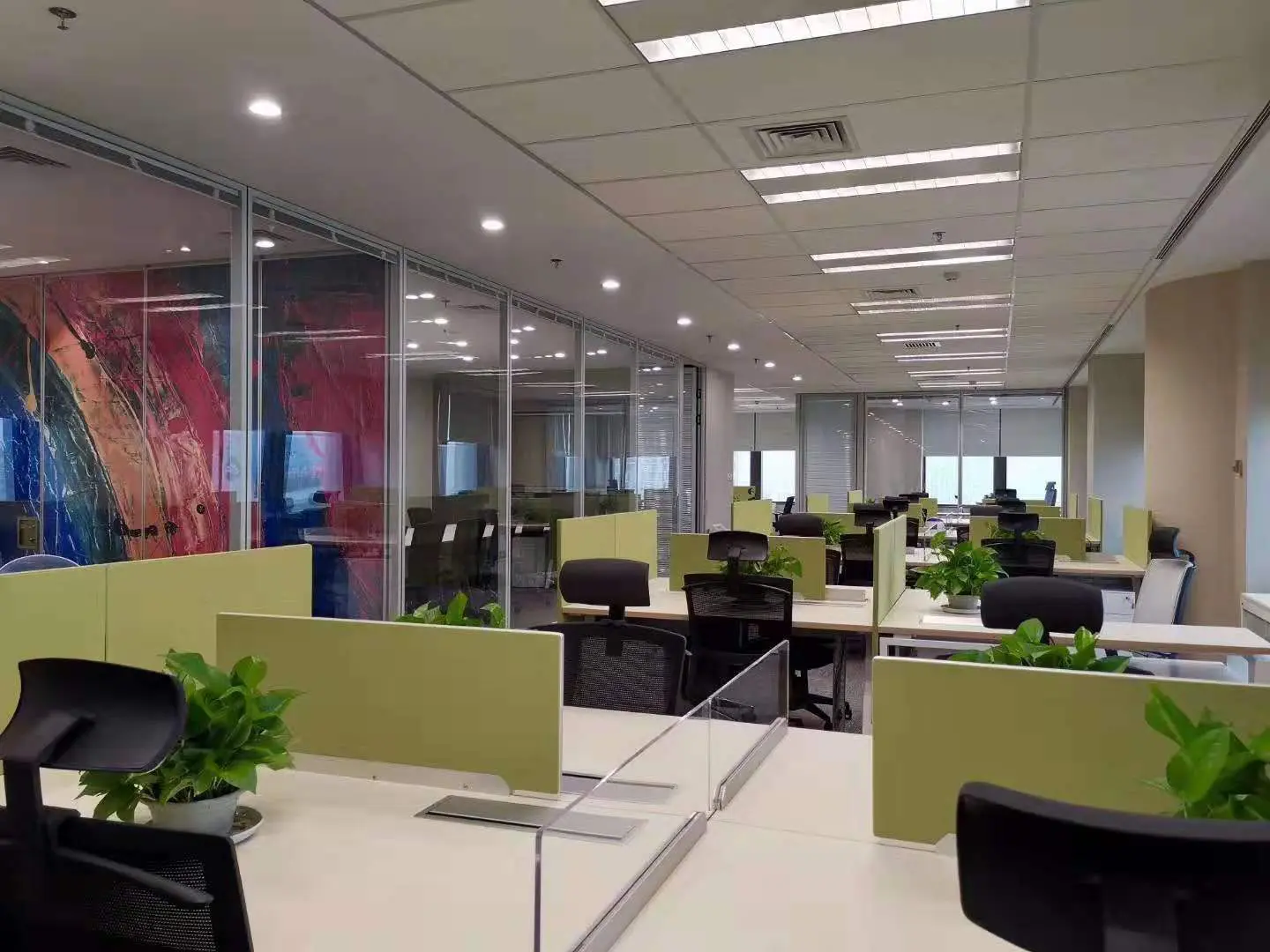
General workstation pods and open meeting rooms: Standard clear glass with no privacy treatment. The space is intentionally transparent — this is the office’s primary aesthetic. ~$220/m² installed (just the partition system, no privacy add).
By matching the privacy tier to each room’s function, Cushman & Wakefield kept their average partition cost close to the standard tier while delivering on-demand privacy where it mattered. Across the floor, smart glass partition installations made up only 12% of total glass area but absorbed about 35% of the privacy-related budget — a focused investment, not a blanket upgrade.
Alternative when smart glass is overkill: Paint Glass
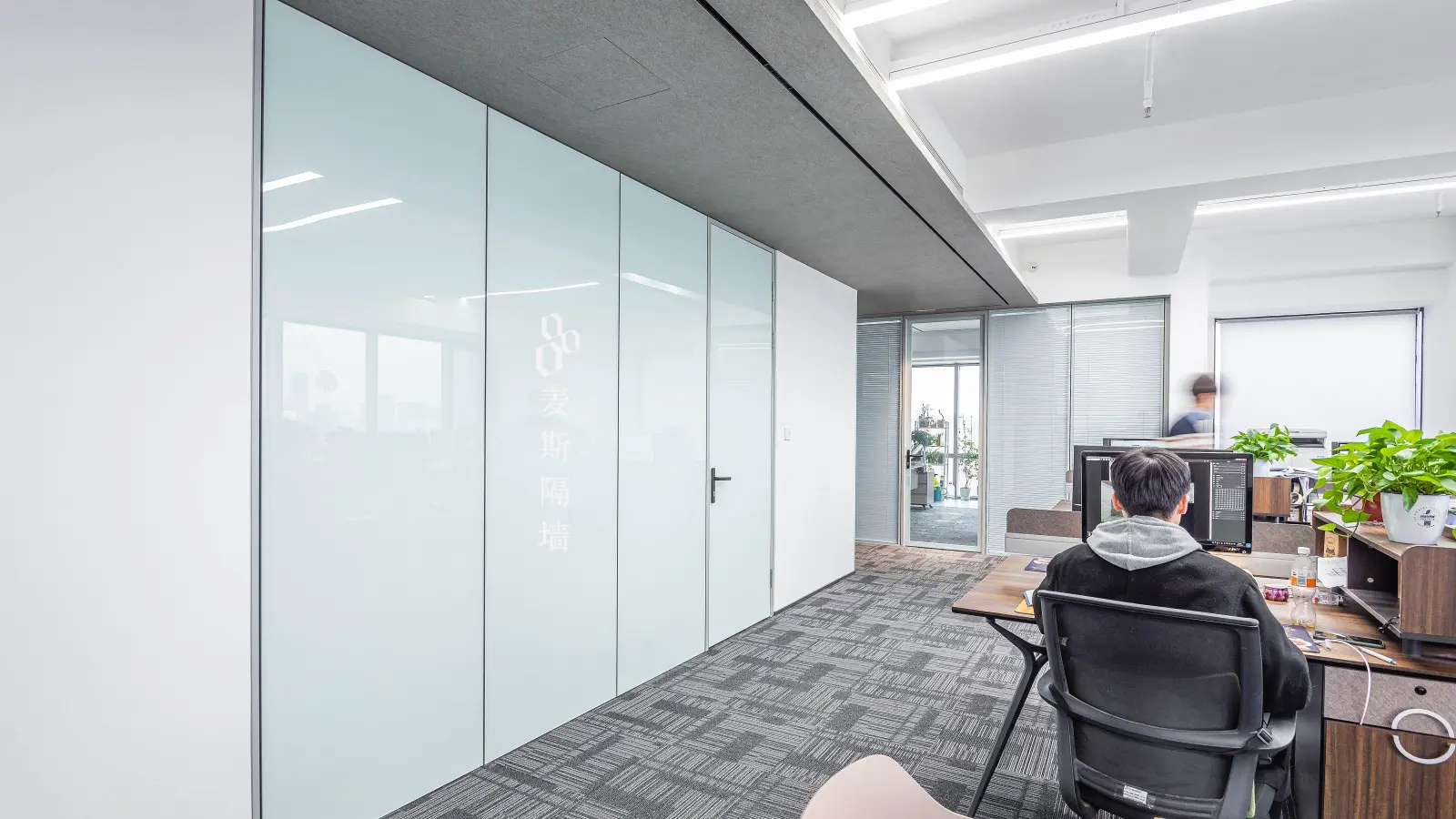
For permanently private rooms where the brief calls for visual identity rather than wayfinding graphics, Paint Glass — back-painted glass in any RAL color — delivers branded permanent privacy at a similar cost to etched glass. It plays the same role as a static smart glass would (always frosted), but with a color statement instead of a frosted aesthetic.
Frequently Asked Questions
How quickly does smart glass partition switch between states?
Under one second from voltage application to fully clear state, and under one second back to frosted when voltage is removed. The transition is sharp rather than gradual — the room goes from private to transparent in a perceptible “switch” moment rather than fading. Some specifications request a gradual transition for executive aesthetics; that requires additional control electronics and adds about 10-15% to the panel cost.
Does smart glass partition work with my existing partition framing?
PDLC smart glass panels mount into our Everest hidden-frame or Great Wall visible-frame systems with the same connection details as standard glass — the only difference is the 24V DC electrical connection at the panel edge, which routes through the integrated cable channel inside the partition. Retrofitting an existing room from clear to smart glass requires swapping the panel and adding the power feed, typically 4-6 hours per panel.
Can frosted film be removed or changed later?
Yes, but it’s labour-intensive. The adhesive bond cures over 6-12 months and becomes increasingly difficult to remove without scoring the glass. Practical removal involves heat (heat gun or steamer), careful scraping, and chemical adhesive remover. Plan 2-3 hours per panel for clean removal of 5-year-old film. For frequent change scenarios, specify a removable-adhesive film at install time — slightly higher cost ($50-70/m² vs $25-45/m²) but much easier to swap.
What happens during a power outage with smart glass partition?
The panel defaults to frosted-opaque state — the safe-fail behavior, since “privacy by default” is usually the desired condition. This means if the building loses power during a meeting, the room becomes more private, not less. For executives who want clear state during outages (rare scenario), specify normally-clear PDLC, which inverts the behavior at the cost of continuous standby power.
Can I integrate smart glass partition with meeting room booking systems?
Yes — most modern smart glass partition controllers support 0-10V analog input, dry contact closure, or Zigbee / Z-Wave wireless control. Integration with Microsoft Teams Rooms, Zoom Rooms, or Outlook calendar systems typically uses dry contact closure triggered by the room’s start-of-meeting event. The frosting transition happens automatically as the call begins, saving the occupant from having to remember to switch privacy on.
How does the smart glass partition affect acoustic performance?
PDLC laminated panels are slightly better acoustic insulators than equivalent thickness single-pane glass — the laminated construction (glass + PDLC + glass) damps mid-frequency sound more than monolithic glass of the same total thickness. Expect 32-34dB Rw vs the 30dB baseline of single tempered glass. For boardroom-grade 45dB acoustic, combine smart glass partition with double-glazed Everest framing — the PDLC layer can be in either glass sheet of the double-glazed assembly.
Spec the Right Privacy Tier for Each Room
Send your floor plan with room functions labeled. We’ll recommend whether each privacy need is best served by smart glass partition, frosted film, etched glass, or Paint Glass — and price the mix so you spend the premium only where it returns value.