
Demountable Partition Wall vs Fixed Wall: 5 Proven Factors
Demountable partition wall or traditional fixed wall — five real tradeoffs to work through before you build: upfront cost vs total cost, speed, lease-end flexibility, acoustic/fire performance, and how it's classified on your books.

Before you get to choosing a partition brand or a finish, there’s a more basic decision that shapes the entire fit-out budget and timeline: does this space actually need a demountable partition wall system, or would a traditional fixed wall do the job for less money? Both answers are correct in different situations — as one facilities-industry look at the category puts it, a demountable wall isn’t really competing with drywall on being a “wall,” it’s competing on what happens after the first day it’s built.
The 30-Second Answer
A demountable partition wall almost always costs more per linear meter to build than a fixed drywall wall — but it usually wins on total cost within two to three reconfigurations, because roughly 95% of the material can be unbolted and reused rather than demolished. If you’re locked into a long lease with no real chance of reconfiguring, a fixed wall’s lower upfront cost is the more rational default. If there’s any realistic chance of relocating, downsizing, or reconfiguring the space before the lease is up, a demountable partition wall usually earns back that higher unit cost and then some.
What You’ll Find Below
Five factors actually decide which one makes sense for a given project: upfront cost vs. total cost, speed to occupy, what happens at lease-end, acoustic and fire performance, and how the wall gets classified on your books. Below that is a side-by-side comparison table, then answers to the questions we hear most often from tenants weighing this decision.
1. Upfront cost vs. total cost of ownership
Fixed wall: cheaper to build the first time
A fixed stud-and-drywall wall is almost always cheaper to build the first time. A demountable partition wall system costs more per linear meter upfront because you’re paying for engineered framing, finished panels, and hardware designed to come apart cleanly rather than get demolished. The upfront comparison alone makes fixed walls look like the obvious choice — and for a space you genuinely never plan to reconfigure, it can be the right one.
Note that “demountable” doesn’t have to mean glass, either — our solid partition system is built on the same reusable framing logic for rooms that need full visual privacy rather than transparency.
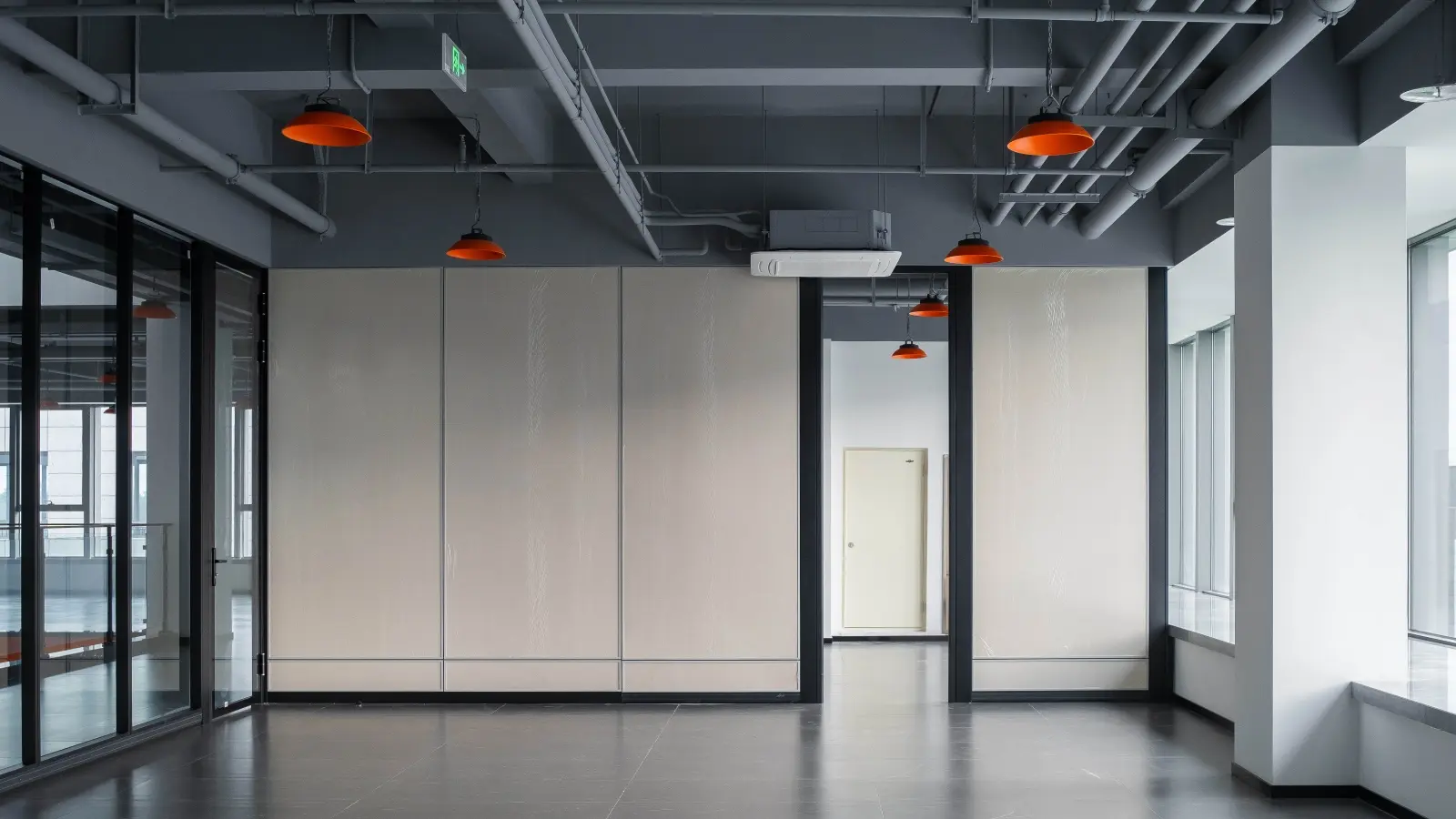
Demountable partition wall: cheaper across multiple reconfigurations
The comparison changes once you look past the first build. A demountable partition wall is, by design, close to fully reusable — in our systems, roughly 95% of the materials in a floor plate can be unbolted, relocated, and reinstalled rather than sent to a skip. If your organization reconfigures every 2-4 years, which is typical for growing companies and most flexible-lease tenants, the second and third reconfiguration is where a demountable system usually wins on total cost, even though it lost the upfront comparison.
2. Speed to occupy
Why modular components install faster
Because a demountable partition wall is pre-engineered and assembled from modular components rather than built up in place, installation typically runs in days rather than the multi-week sequence a fixed wall requires — framing, drywall, taping, sanding, priming, and paint, each with its own dry time and trade handoff. We cover the construction-timeline comparison in more detail in how much faster modular partitions are to build.
How that offsets the higher unit cost
Faster occupancy directly offsets some of the higher unit cost from point 1, especially when rent or a move-in deadline is running during construction — every week of construction on a leased space is a week of rent paid on a space you can’t yet use.
3. What happens at lease-end or the next reconfiguration
Fixed wall: demolition and possible dilapidation cost
This is the tradeoff most first-time tenants underweight. A fixed wall is, structurally, part of the building the moment it’s built — removing it at lease-end is demolition, and depending on your lease terms, you may be responsible for restoring the space to its original condition (a dilapidation cost that can run into real money on a large floor plate).
Demountable partition wall: unbolt, relocate, or resell
A demountable partition wall can be unbolted and taken with you, sold, or reconfigured on the spot without a demolition contractor. If you expect to be in this space for the full term of a long lease with zero layout changes, this tradeoff barely matters. If there’s any real chance of relocating, subleasing, downsizing, or expanding before the lease is up, it matters a lot — workplace consultants comparing the two construction types generally flag this lease-end exposure as the single biggest total-cost variable tenants underestimate going in.
4. Acoustic and fire performance — don’t assume, check the actual rating
The performance gap isn’t automatic
There’s a common assumption that a “real wall” always outperforms a demountable partition wall acoustically and for fire safety. That’s not automatically true in either direction. A basic single-layer drywall stud wall and a basic single-glazed demountable partition can land in a similar acoustic range; a well-specified demountable system — our Everest double-glazed partition, for example, engineered for roughly 45dB of sound reduction — can outperform a poorly detailed drywall assembly with unsealed penetrations. The reverse is just as true if the drywall wall is well-built and the partition spec is basic.
How to actually compare two options
The only reliable way to compare is to ask for the actual tested rating (Rw or STC, not a marketing adjective) for both options, matched to what the room actually needs — we go through how to read and specify that in our partition specification checklist.
5. How it gets classified on your books
Fixed wall: leasehold improvement
A fixed wall built into the space is typically capitalized as a leasehold improvement, depreciated over the shorter of its useful life or the remaining lease term, and it stays with the building when you leave.
Demountable partition wall: often furniture/equipment
A demountable partition wall, because it isn’t permanently fixed to the structure, is commonly treated as furniture/equipment in many jurisdictions — which can mean a different depreciation schedule and the ability to take it with you or resell it as an asset. Treatment varies by jurisdiction and specific lease language, so this is a conversation for your accountant and landlord, not something to assume from a product brochure — ours included.
Demountable Partition Wall vs. Fixed Wall at a Glance
| Factor | Fixed Wall | Demountable Partition Wall |
|---|---|---|
| Upfront cost per linear meter | Lower | Higher |
| Cost after 2-3 reconfigurations | Higher (rebuild each time) | Usually lower (≈95% reusable) |
| Typical install time | Multi-week (framing → paint) | Days (pre-engineered components) |
| Lease-end handling | Demolition, possible dilapidation cost | Unbolt, relocate, or resell |
| Acoustic/fire performance | Depends on spec, not category | Depends on spec, not category |
| Typical book classification | Leasehold improvement | Often furniture/equipment |
So Which One Should You Actually Choose?
As a rough heuristic: the longer and more certain your lease term, and the less likely your layout is to change, the more a fixed wall’s lower upfront cost makes sense. The shorter your horizon, the more your headcount is likely to change, or the more your lease already assumes you’ll restore the space at the end, the more a demountable partition wall’s reusability and lease-end flexibility earns back its higher unit cost. Most growing companies and flexible-lease tenants land on the demountable side once they actually run the total-cost math instead of comparing only the first invoice.
Frequently Asked Questions
Is a demountable partition wall actually cheaper than a fixed wall over time?
Usually yes if you reconfigure more than once, because a large share of the materials are reusable rather than demolished. It’s usually more expensive if you build it once and never touch it again — the total-cost advantage depends on how often you expect to reconfigure.
Can a demountable partition wall meet the same fire rating as a fixed wall?
It depends on the specific system and configuration, not the category as a whole — ask for the tested fire rating for your exact glass/panel and framing spec rather than assuming either category automatically wins.
How long does it take to install a demountable partition wall compared to drywall?
Because the components are pre-engineered off-site, installation typically runs in days rather than the multi-week sequence drywall construction requires, though exact timelines depend on project scope.
Is a demountable partition wall classified as furniture or as construction?
In many jurisdictions it’s treated as furniture/equipment rather than a leasehold improvement, since it isn’t permanently fixed to the building structure — confirm the specific treatment with your accountant, since rules vary.
Can I mix demountable partitions with some fixed walls in the same fit-out?
Yes — many floor plates use fixed walls around core/structural areas (stairwells, risers, restrooms) and a demountable partition wall system everywhere else that’s likely to be reconfigured. It’s not an all-or-nothing decision.
Get Help Choosing for Your Floor Plate
Working through this decision for a specific floor plate? Talk to us about your layout and we can help you run the total-cost comparison for your actual reconfiguration timeline.