WELL Building Acoustics: 5 Proven Partition Strategies
How WELL Building Standard and LEED actually evaluate office acoustics, and where a modular partition wall's NIC rating, reverberation performance, and documentation fit into a real certification submission — not just a marketing decibel number.

If you’ve searched anything like “WELL building standard compliant acoustic pod options” or “does this partition system help with LEED acoustic credit,” you’ve probably found a lot of general WELL/LEED overview content and not much that connects a real partition product to a real acoustic requirement. This is a piece specifically about WELL building acoustics — what the standard’s Sound concept actually asks for, and where a modular partition wall or an enclosed Mini Office Pod does or doesn’t help you get there.
The 30-Second Answer
A modular partition wall system can help with several WELL building acoustics requirements — particularly the Sound Barriers feature, which sets a minimum Noise Isolation Class (NIC) of 35-40 for general enclosed offices and NIC 53 for conference and teleconference rooms. But a partition wall alone doesn’t get a project certified.
WELL and LEED both evaluate field-measured, tested performance across several separate features — acoustic zoning, sound barriers, reverberation time, sound masking, and documentation — and a manufacturer’s lab-tested sound rating (Rw or dB) is not automatically the same number as the field-measured NIC an assessor will check after installation. Treat this as a starting point for a conversation with your acoustic consultant or WELL AP, not as certification advice on its own.
What You’ll Find Below
Five things actually decide whether your partition and room layout choices support a WELL or LEED acoustic submission: how you zone loud and quiet areas, what the partition walls themselves need to achieve, what happens to sound once it’s inside the room, how sound masking fits around your partition boundaries, and what documentation an assessor actually wants to see. Together they’re the practical side of WELL building acoustics — the part beyond the standard’s own overview pages.
There’s also a comparison table matching our two partition systems against WELL’s stated targets, and answers to the specific questions we see people searching for on this topic.
1. Acoustic Zoning — the First WELL Building Acoustics Decision
What WELL means by “zoning”
Before any single wall’s rating matters, WELL’s Sound concept asks a project to categorize spaces as loud, quiet, or mixed-use and lay them out so a quiet task (a call, a 1:1, focused work) isn’t sitting next to a loud one (a break room, a print station, an open collaboration zone) with nothing between them. This is a planning decision, not a product spec — it happens before you pick a partition system.
Where an enclosed room does this work
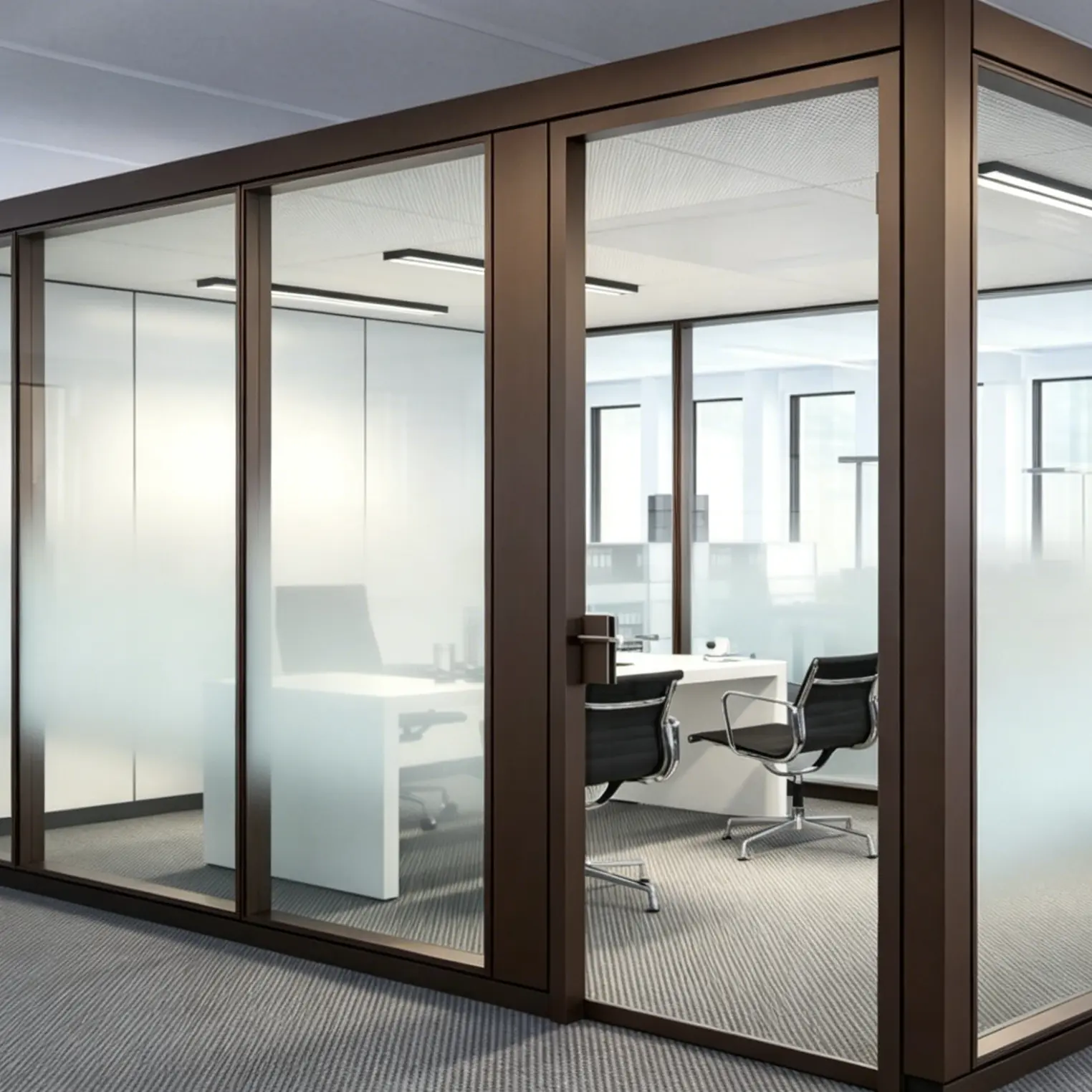
Once the zoning plan exists, an enclosed room is one of the more direct ways to execute it. Our Mini Office Pod — a fully enclosed 4-9m² room, not an open workstation — is built specifically to give a quiet zone its own boundary rather than relying on distance or furniture layout alone.
Whether that boundary actually meets a WELL building acoustics performance threshold is a separate question, and it’s the one that trips up most projects — covered next.
2. Sound Barriers Between Rooms — Meet the NIC Threshold, Not Just “Soundproof”
What WELL’s Sound Barriers feature actually requires
According to the official WELL v4 Sound Barriers feature, a general enclosed office needs a minimum NIC of 35 if a sound masking system is present, or NIC 40 if there isn’t one — and walls adjoining private offices, conference rooms, or other teleconference rooms need a stricter minimum NIC of 53. NIC is a field measurement taken on the installed assembly, not a number you can get from a spec sheet alone. This single feature is the most partition-relevant piece of WELL building acoustics, which is why it’s worth understanding before you compare panel specs.
Manufacturer ratings vs. field NIC — why they’re not the same number
Per our factory specifications, the Great Wall framed partition system is rated for roughly 30dB of sound insulation, and the Everest frameless system for roughly 45dB — both lab-tested figures on the panel assembly itself.
Field-measured NIC on an installed wall is typically lower than a lab rating, because it also captures flanking paths the lab test doesn’t see: door seals, ceiling plenum leakage, wall-to-floor junctions, and anything penetrating the wall like outlets or ductwork. A higher-spec panel gives more margin to work with, but the installed NIC number still has to be verified on-site — we go through how to specify and verify that in our partition specification checklist.
3. Reverberation Time Inside the Room
The RT60 target for meeting rooms
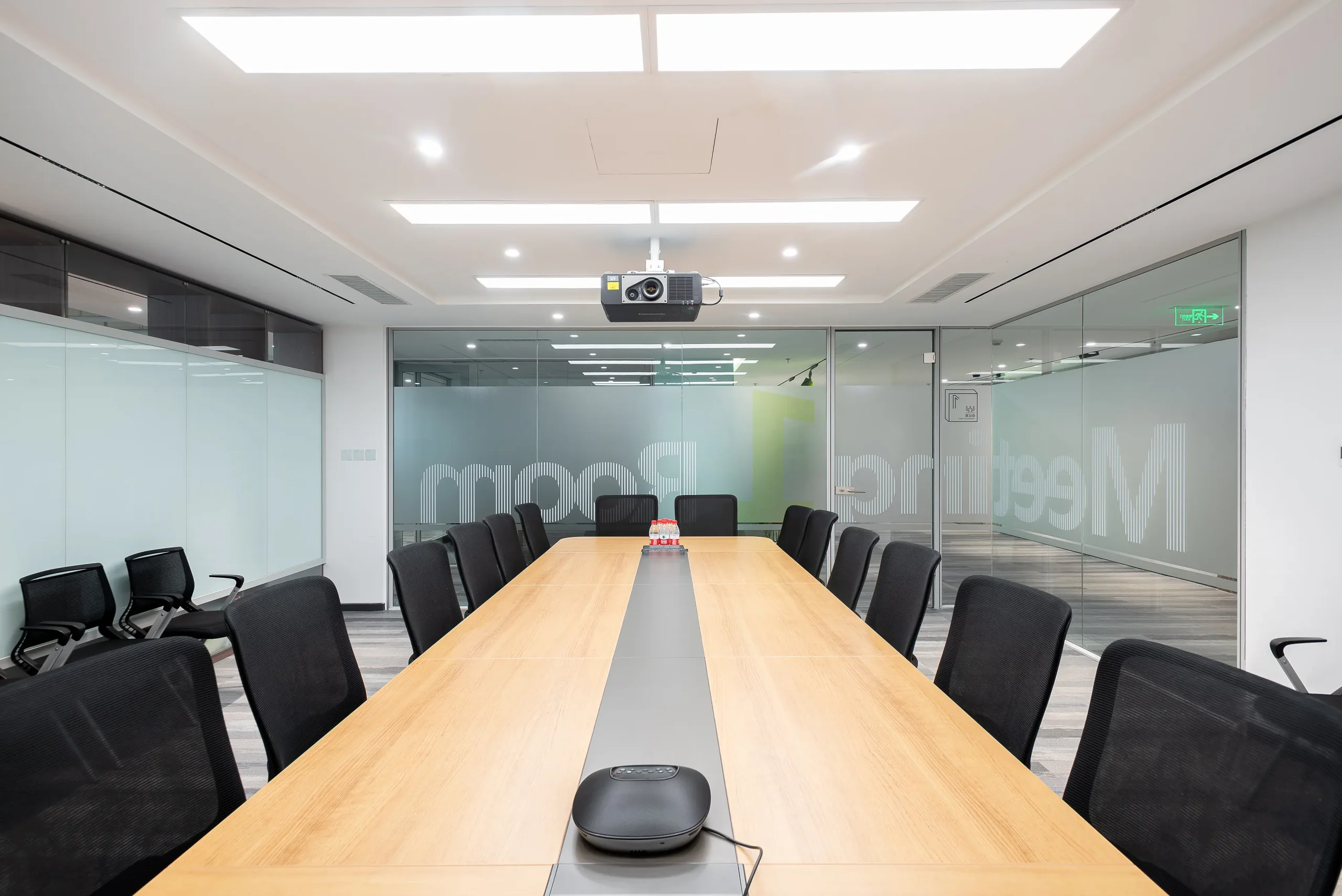
Getting sound to stay out of a room is only half of WELL building acoustics — WELL also looks at reverberation time (RT60) inside it, with a target of roughly 0.6 seconds for conference rooms. A hard-surfaced room with a glass wall, a hard floor, and a hard ceiling can meet the sound-barrier NIC target and still have a noticeably echoey, fatiguing acoustic inside it.
What the partition wall doesn’t solve on its own
A partition system controls what crosses the boundary; it does nothing for reverberation once you’re inside. WELL’s broader Sound strategy calls for absorptive ceiling and wall surfaces — a minimum Noise Reduction Coefficient around 0.7, covering roughly a quarter of the walls and half the ceiling — to bring RT60 down. That’s an interior finishes and ceiling-tile decision layered on top of the partition choice, not a substitute for it.
4. Sound Masking at the Partition Boundary
Why masking and partitions work together, not instead of each other
Sound masking — a low-level, engineered background sound, not literal white noise — is one of the reasons WELL allows a lower NIC 35 threshold for general enclosed offices when a masking system is present, versus NIC 40 without one. Masking raises the ambient noise floor enough that speech crossing a boundary becomes harder to make out, effectively buying back some of the isolation a slightly lower-rated wall doesn’t provide on its own.
Where it matters most on a floor plate
Masking earns the most value at the edges of open-plan areas and around enclosed rooms with a lower sound-barrier target. It’s rarely worth engineering into every single conference room, where you’d rather just spec the higher NIC 53 wall — our Everest system, for example — and skip depending on masking for the sensitive conversations that happen there.
5. Documenting the Rating for Your Certification Submission
What a WELL or LEED assessor actually wants to see
A marketing decibel number on a product page isn’t documentation. An assessor wants test data tied to the actual assembly being installed — lab test reports referencing a recognized standard, ideally from an accredited acoustic testing lab, plus field verification of the installed NIC once construction is complete for the Sound Barriers feature specifically. LEED’s own acoustic performance credit works the same way, evaluated against its own separate performance metrics for background noise, reverberation, and sound isolation — worth confirming with your LEED consultant early, since it’s not the same scoring system as WELL’s.
Getting that from your manufacturer
Ask any partition manufacturer for the actual test report behind a stated sound rating, not just the number — and ask whether it’s a lab rating (like Rw) or a field rating (like NIC), since a certification submission needs to reference the right one for the right feature.
We operate under ISO 9001 quality management, which is the kind of documented process an assessor or acoustic consultant will want to see referenced when you’re building the certification package. Good documentation is what turns a partition choice into real evidence for a WELL building acoustics submission, not just a product spec sheet — and it’s the difference between a manufacturer claim and something your WELL AP can actually cite.
Great Wall vs. Everest: Matching Panel Choice to a WELL Building Acoustics Target
| WELL Sound Barriers Target | Great Wall (~30dB rated) | Everest (~45dB rated) |
|---|---|---|
| General enclosed office, NIC 35 (with masking) | Workable starting point, field-verify | Comfortable margin |
| General enclosed office, NIC 40 (no masking) | Field verification essential | Comfortable margin |
| Conference/teleconference room, NIC 53 | Not recommended without added treatment | Better starting point, still field-verify |
| Typical use case on our projects | Open-plan private offices, general enclosure | Conference rooms, boardrooms, sensitive calls |
So Does a Modular Partition System Actually Get You Certified?
No single product gets a project certified under WELL or LEED — both standards score a building across many features, and Sound is only one concept among several. What a well-specified partition system does is remove one of the harder pieces of WELL building acoustics from your plate: a real, verifiable sound barrier between rooms, chosen against the actual NIC target rather than a generic “soundproof” claim. Treat a partition manufacturer as one input into your WELL building acoustics package, not the whole submission.
The reverberation, masking, and documentation pieces still need their own attention, usually from an acoustic consultant or WELL AP working alongside your architect. We’re not that consultant — but we can tell you exactly what our panels are rated for and back it with real test data, which is the input that consultant actually needs from a manufacturer. For more detail on the WELL v2 Sound concept beyond partition walls, this overview of the standard’s full Sound strategy covers the absorption and masking pieces in more depth than we do here.
Frequently Asked Questions
What WELL Building Standard compliant acoustic pod options are available for commercial offices?
We don’t manufacture standalone single-person acoustic phone booths. Our enclosed-room product is the Mini Office Pod (4-9m²), built on modular partition framing that can be specified toward WELL building acoustics targets — specifically the Sound Barriers NIC threshold — see the comparison table above for which of our two systems fits which target.
Do office pods contribute to WELL building acoustics certification?
An enclosed room contributes to the Acoustic Zoning strategy and can help meet the Sound Barriers feature if its walls hit the required NIC rating for its use — but certification is scored at the project level across multiple Sound features (zoning, barriers, reverberation, masking, documentation), not awarded for a single product.
What LEED-compliant acoustic options exist for commercial office fit-outs?
LEED’s acoustic performance credit evaluates background noise, reverberation time, and sound isolation with its own performance metrics, separate from WELL’s. A partition system with real, documented test data — not just a marketing decibel figure — is the useful input here too; talk to your LEED consultant about which credit path your project is pursuing before finalizing a partition spec.
Does a higher decibel rating on a partition wall automatically satisfy WELL’s Sound Barriers requirement?
No. Within WELL building acoustics, the Sound Barriers feature is checked against field-measured NIC on the installed assembly, which typically comes in lower than a manufacturer’s lab-tested rating because it also captures flanking paths like door seals and ceiling plenum leakage. A higher-rated panel gives more margin, but the installed result still needs field verification.
Can I mix Great Wall and Everest partitions in one WELL-targeting project?
Yes — many of our projects use Great Wall for general enclosed offices and Everest for conference rooms and higher-sensitivity spaces, which lines up reasonably well with WELL’s own tiered NIC targets of 35-40 for general offices versus 53 for conference and teleconference rooms.
Get Acoustic Spec Support for Your Certification Project
Working through partition specification for a WELL or LEED-targeting project? Talk to us about your acoustic targets and we’ll walk through which system and configuration fits your NIC requirement, backed by real test data rather than a marketing number. For the broader WELL building acoustics picture — lighting, materials, and layout beyond sound — see our guide to WELL-certified office design.