LEED Glass Partition: 6 Proven Credit Paths and Best Specs
LEED certifies projects, not products. This guide shows which LEED v5 and v4.1 credits a glass partition can support, from low-emitting materials to reuse, daylight, views and sound, and what evidence to ask your supplier for.

Search for a LEED glass partition and you will find plenty of suppliers calling their walls “LEED certified.” That label does not exist. LEED certifies buildings and interiors, not products. What a partition can do is help a project earn specific credits, provided it comes with the right evidence.
This guide explains which credits a LEED glass partition actually touches under LEED v5 and LEED v4.1, what documentation each one needs, and what to ask a supplier before the partition package is ordered. Where it helps, we use our own glass partition system and its 2026 SGS verification as a worked example.
The 30-Second Answer
A LEED glass partition is a partition specified and documented so that it supports a project’s LEED credits. It contributes most directly to Low-Emitting Materials, through third-party VOC emissions testing of the complete system, not just the glass. It can also support reuse and waste credits if the system is demountable, daylight and quality views because glass keeps sightlines open, and the sound environment if the acoustic rating matches the room.
None of these points are automatic. Each one depends on paperwork the LEED consultant can submit: an emissions test to the right method, reuse and waste records, and acoustic data tied to a standard. Ask for that evidence at the quotation stage, not after installation.
What You’ll Find Below
Six sections, each covering one way a LEED glass partition can contribute, followed by a credit map, a supplier document checklist and answers to the questions project teams ask most often. The credit names and point values come from LEED v5 for interiors (ID+C) unless we say otherwise, because most glass partition packages sit inside an interior fit-out.
1. Products Don’t Earn LEED Points. Projects Do.
Before looking at credits, it helps to be precise about what a LEED glass partition is. LEED is a rating system for projects. A project team chooses credits, collects documentation, and submits it for review. Products enter that process as evidence. A LEED glass partition with the right test report makes a credit easier to document; a partition without one can make the same credit harder or impossible.
LEED v5 and LEED v4.1 are both in use
The U.S. Green Building Council opened registration for LEED v5 on 28 April 2025 for new construction, interiors and existing buildings, with decarbonization accounting for half of all available points. Projects registered earlier may still be working under LEED v4.1, so a LEED glass partition specification should state which version the evidence supports.
Why the wording matters
“LEED certified glass partition” on a quotation is a warning sign, not a selling point. It usually means the supplier has not looked at which credit they claim to help with. The right wording names the credit and the evidence, for example: “glass partition system tested to CDPH Standard Method v1.2-2017 for the LEED Low-Emitting Materials credit.”
2. Low-Emitting Materials: Where a LEED Glass Partition Matters Most
Low-Emitting Materials rewards projects that limit volatile organic compound (VOC) emissions from interior products. It is the credit where a LEED glass partition has the clearest role, and also the one most often misunderstood.
Under LEED v4.1
In LEED v4.1 the credit sits in Indoor Environmental Quality and is scored by product category. According to the LEED v4.1 credit summary on LEEDuser, at least 75% of wall panels by cost or surface area, 90% of ceilings and flooring, and 75% of furniture by cost must meet the emissions evaluation, be inherently nonemitting, or be salvaged and reused. Points depend on how many categories comply: two categories earn one point, three earn two, and more categories at higher thresholds earn up to three.
Emissions testing follows the California Department of Public Health (CDPH) Standard Method v1.2-2017. Total VOCs are measured after 14 days and reported in one of three ranges: 0.5 mg/m³ or less, between 0.5 and 5 mg/m³, or 5 mg/m³ or more. Products outside schools are modelled to the private office scenario, and the testing laboratory must be ISO/IEC 17025 accredited.
Under LEED v5
LEED v5 moves Low-Emitting Materials into Materials and Resources. The LEED v5 ID+C fact sheet lists it at up to 4 points within a 26-point Materials and Resources category. As summarised by SCS Global Services, the credit covers walls and furniture, places movable and demountable partitions in the furniture category, and awards one point for more than 90% compliance in any two categories. Green Badger notes that compliance is now based on emissions testing alone, with VOC content limits no longer required.
| Item | LEED v4.1 | LEED v5 (ID+C) |
|---|---|---|
| Credit category | Indoor Environmental Quality | Materials and Resources |
| Maximum points | 3 (plus exemplary performance) | 4 |
| Where a glass partition is counted | Wall panels (or furniture, depending on the product) | Walls, or furniture for movable and demountable partitions |
| Emissions test method | CDPH Standard Method v1.2-2017 | CDPH Standard Method v1.2-2017 |
| Other routes | Inherently nonemitting, salvaged or reused | Inherently nonemitting, salvaged or reused |
“Glass doesn’t emit anything” is only half true
LEED treats glass, stone, ceramic, concrete, powder-coated metal and plated or anodized metal as inherently nonemitting, so they need no emissions test. The catch is the condition attached: the product must have no binders, surface coatings or sealants that contain organic chemicals, and the product is judged as a whole.
A glass partition system is not just glass. Our Great Wall series holds the glass with snap-fit profiles and EPDM rubber seals. Everest bonds the glass with 3M structural tape. Both use powder-coated or fluorocarbon-finished aluminium and a hard plastic secondary fixing. Seals, tapes and finishes are exactly the organic components that can take a system out of the inherently nonemitting route. That is why a LEED glass partition needs an emissions test of the complete system, not a statement that glass is inert.
3. What Third-Party VOC Evidence Looks Like
For a LEED glass partition, the useful document is not a brochure claim but a test-based verification you can hand to the LEED consultant. Here is what ours contains, as an example of what to look for in any supplier’s paperwork.
Our 2026 SGS verification, in plain terms
In June 2026, SGS-CSTC Standards Technical Services in Guangzhou issued a Verification of Conformity for LEED covering our Glass Partition System, product type wall panels. It applies to our glass partition systems, including the Great Wall and Everest series. The sample was tested between 16 April and 26 May 2026 to CDPH Standard Method v1.2-2017 and complied with the VOC limits in Table 4-1 of the method. Total VOCs after 336 hours were reported below 0.5 mg/m³ in both the private office and the school classroom scenario.
The conclusion printed on the verification is that the product qualifies for LEED v4.1 and LEED v5 projects under the Low-Emitting Materials credit for VOC emissions. The SGS laboratory is ISO/IEC 17025 accredited, and the verification carries a report number that can be checked on SGS’s online verification portal.
What the verification does not say
It covers VOC emissions. It does not certify the project, it does not cover acoustic or fire performance, and, like every test of this kind, its results apply to the sample tested. For a LEED glass partition package, ask the supplier to confirm that the system you are buying matches the system that was tested.
4. Reuse and Waste Diversion: The Demountable LEED Glass Partition
Low-Emitting Materials is about what a LEED glass partition releases into the air. The next group of credits is about what happens to it at the end of a fit-out. In the LEED v5 ID+C fact sheet, Interior Materials Reuse is worth up to 4 points and Construction and Demolition Waste Diversion up to 4 more.
Reuse is a design decision, not a disposal decision
A demountable LEED glass partition is built from factory modules that are fixed together mechanically, so it can be taken down and reinstalled rather than broken out. For our modular series we publish a 95% reuse rate and a recycling rate above 85% for the partition materials. Those two figures measure different things: reuse means the module goes back up as a wall, recycling means its materials are recovered.
For a reuse credit, the evidence is a record of which modules came from where and went where. If the project is relocating an existing demountable system, inventory it before the old site is stripped. Our guide to the parts of a demountable wall system explains which components decide whether a wall survives a move.
Less site waste from the start
Around 90% of the work on our modular partitions is done in the factory, which means fewer offcuts, less packaging waste and less wet trade on site. That does not earn a credit by itself, but it makes the waste diversion numbers easier to hit. The cost and lease side of the same choice is covered in our comparison of a demountable partition wall vs a fixed wall.
5. Daylight and Quality Views: Glass Keeps the Core Connected
LEED v5 groups daylight, views, thermal comfort, sound and lighting into one Indoor Environmental Quality credit, Occupant Experience, worth up to 7 points in ID+C. Two of its paths are directly affected by choosing a LEED glass partition over a solid wall.
Quality Views
Under the LEED v5 Occupant Experience credit, the Quality Views path awards 2 points when occupants in 75% of regularly occupied floor area have a view to the outdoor environment, and 3 points at 90%. The glazing in the view must have a visible light transmittance above 40%, and occupants must be within three times the glazing head height.
Proximity to Windows
A separate path awards 1 point when at least 30% of regularly occupied area sits within 6 metres of envelope glazing with visible light transmittance above 40%, excluding areas that are blocked from the windows.
Where a LEED glass partition helps
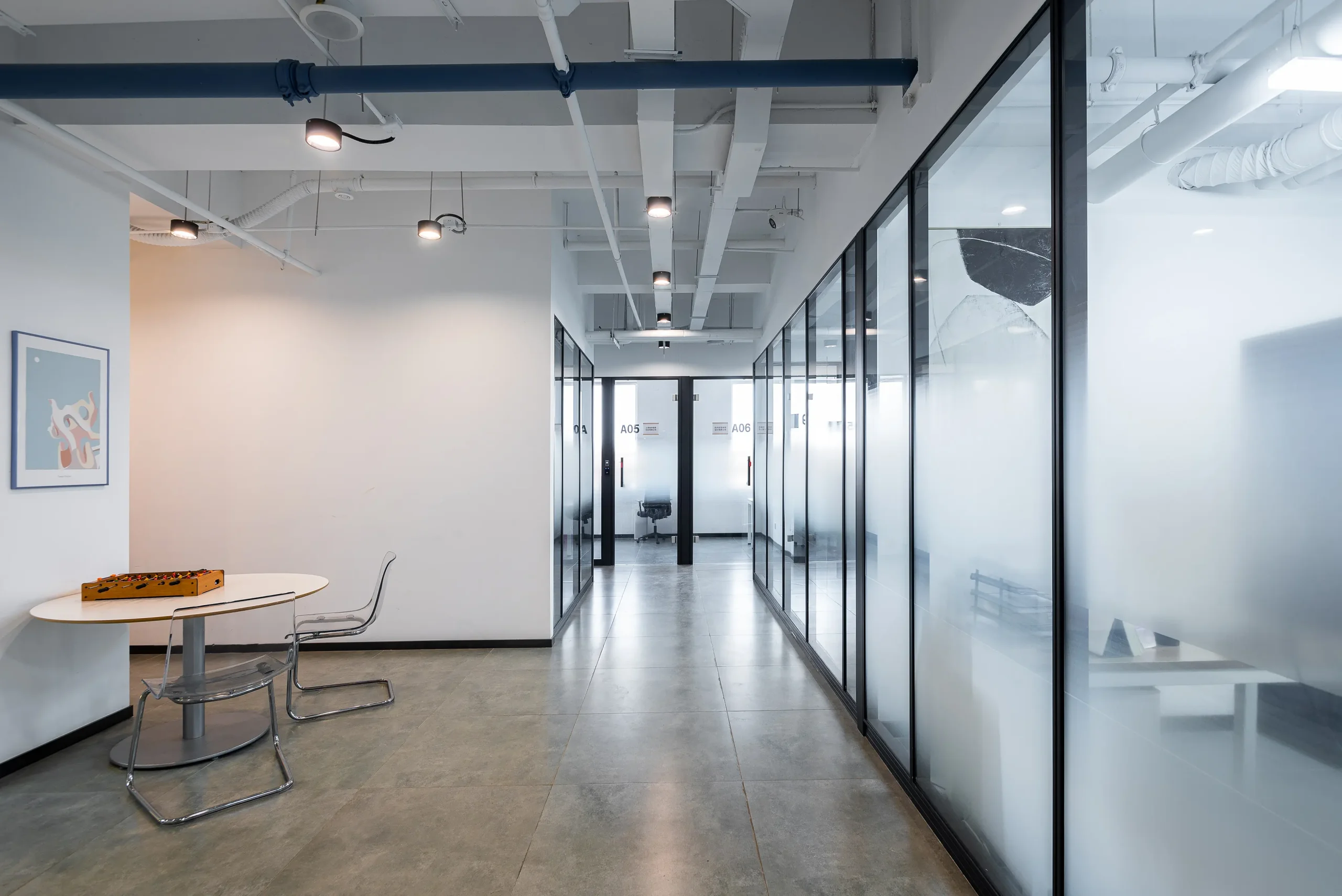
Both paths are measured to the building’s windows, not to the partitions. What partitions decide is whether interior rooms are cut off from those windows. A solid wall around a perimeter office can block the view and daylight for everyone behind it; a clear LEED glass partition keeps the sightline open. Whether interior glazing counts in the view calculation, and at what visible light transmittance, is a question for the project’s LEED consultant, so share the glass specification with them early.
Frosted film, blinds and decorative manifestation on a LEED glass partition change the picture. If privacy is needed at desk height, keep a clear band above it so the view line survives. Our guide to WELL certified office design covers the same daylight trade-offs from the WELL side.
6. Sound Environment: Match the Acoustic Rating to the Room
The same Occupant Experience credit includes a Sound Environment option worth up to 2 points. Path 1 earns 1 point for mapping the acoustic expectations of each primary space early in design. Path 2 earns 2 points for showing, through calculation, modelling or measurement, that the design meets acoustic criteria in at least 75% of occupied spaces.
What partition data the acoustic consultant needs
A LEED glass partition’s acoustic performance is one input into that calculation, alongside ceilings, doors, flanking paths and background noise. For our series, the catalogue gives around 30 dB for Great Wall and around 45 dB for Everest. Those are manufacturer series values, not field results, so give the consultant the glazing build-up and ask which standard the figure was tested to.
Double glazing is the usual route when a LEED glass partition needs more separation. Our guide to double glazed glass partition acoustics explains how spacing and glass thickness affect performance, and our WELL building acoustics guide covers zoning loud and quiet areas, which is the same exercise Sound Environment Path 1 asks for.
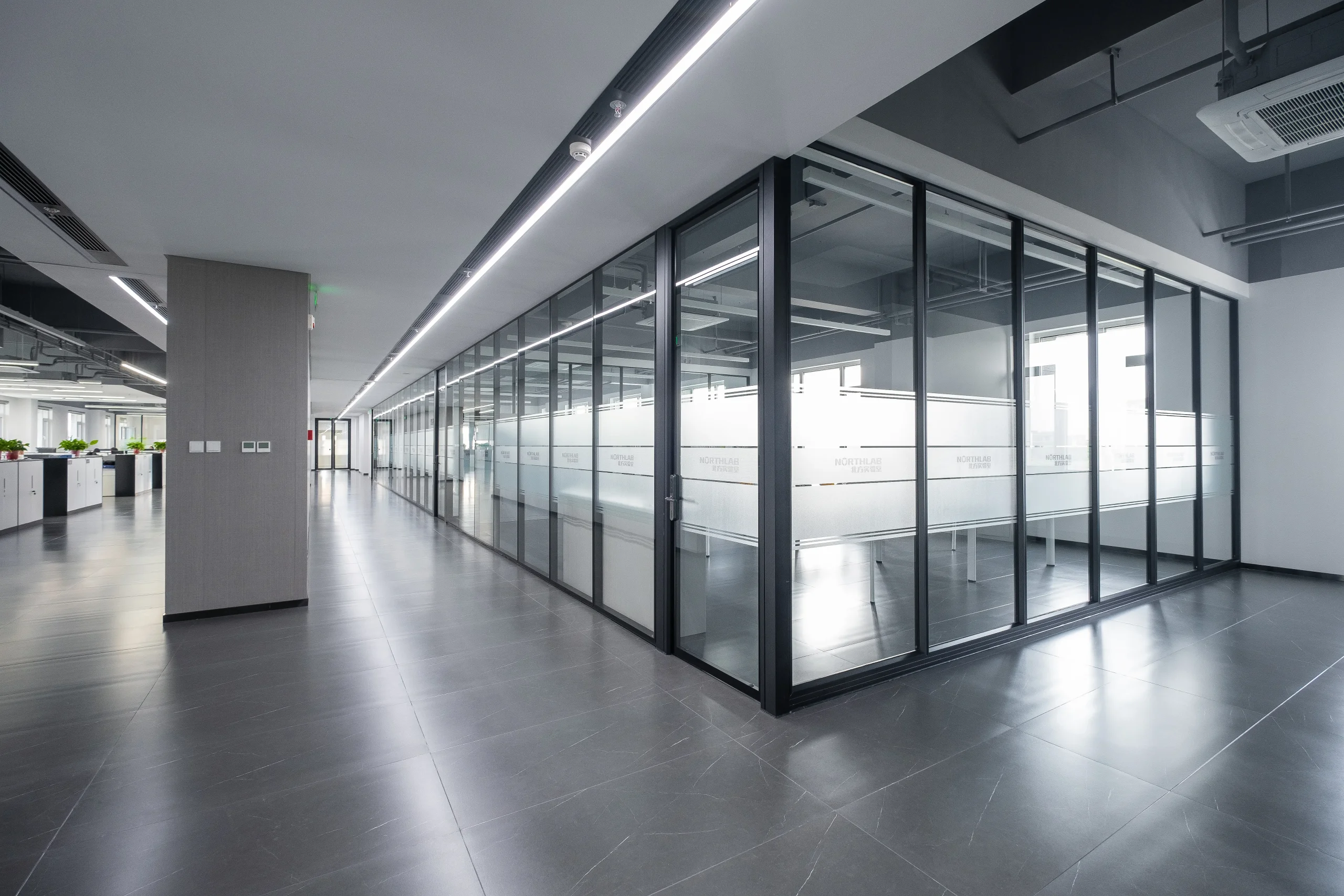
LEED Glass Partition Credit Map
The table below brings the six sections together. It shows where a LEED glass partition can contribute and what evidence the project will need.
| LEED v5 ID+C credit | Points | How a LEED glass partition contributes | Evidence to request |
|---|---|---|---|
| Low-Emitting Materials (MR) | Up to 4 | VOC emissions of the complete system | CDPH v1.2-2017 test or third-party verification |
| Interior Materials Reuse (MR) | Up to 4 | Relocating existing demountable modules | Module inventory and reuse records |
| C&D Waste Diversion (MR) | Up to 4 | Prefabrication reduces site waste | Waste and recycling records |
| Building Product Selection and Procurement (MR) | Up to 10 | Depends on product disclosures and certifications | Ask the supplier what documentation exists |
| Occupant Experience: Quality Views and daylight paths (EQ) | Part of up to 7 | Keeps sightlines to perimeter windows open | Glass specification and layout drawings |
| Occupant Experience: Sound Environment (EQ) | Up to 2 | Acoustic separation between rooms | Acoustic rating with test standard and glazing build-up |
Point values come from the LEED v5 ID+C fact sheet and the LEED v5 Occupant Experience credit. Building design and construction (BD+C) projects use different point values for some of these credits.
How to Specify a LEED Glass Partition
Most problems with a LEED glass partition start at tender, when the specification says “LEED compliant” and nothing else. Write the evidence into the specification instead.
- Name the version. State whether the project is pursuing LEED v5 or LEED v4.1, because category names and point structures differ.
- Name the credit. List the credits the partition package is expected to support, starting with Low-Emitting Materials.
- Ask for system-level emissions evidence. Require a CDPH Standard Method v1.2-2017 result for the assembled LEED glass partition system, with the exposure scenario and TVOC range stated, from an ISO/IEC 17025 accredited laboratory.
- Confirm the tested system matches the supplied system. Seals, tapes and finishes should be the same as in the test sample.
- Plan reuse at the start. If the partitions are meant to move with the tenant, specify a demountable system and keep module records from day one.
- Keep the views. Agree where clear glazing is needed for daylight and views before privacy film or blinds are added.
- Tie acoustics to a standard. Ask for the rating, the test standard and the exact glazing build-up for each room type.
Our office glass partition specification checklist turns these points into a full project brief, and our modular glass partition systems page sets out the series we supply, from the visible-frame Great Wall to the hidden-frame Everest.
Frequently Asked Questions
Is there such a thing as a LEED certified glass partition?
No. LEED certifies projects, not products. A glass partition can support specific credits, such as Low-Emitting Materials, when it comes with the right evidence. Treat “LEED certified product” on a quotation as a reason to ask which credit the supplier means and what documentation they have.
Which credit does a LEED glass partition contribute to most?
Low-Emitting Materials. In LEED v5 it sits in Materials and Resources and is worth up to 4 points for interiors projects. A LEED glass partition supports it through VOC emissions testing of the complete system to CDPH Standard Method v1.2-2017.
Doesn’t glass count as inherently nonemitting?
Glass on its own does. A LEED glass partition system also contains seals, tapes, plastic fixings and finishes, and LEED’s inherently nonemitting route only applies when a product has no organic binders, coatings or sealants. That is why the assembled system needs its own emissions test.
Does a LEED glass partition help with LEED v4.1 projects too?
Yes, if the evidence matches. LEED v4.1 places Low-Emitting Materials in Indoor Environmental Quality and uses the same CDPH Standard Method v1.2-2017. Our SGS verification states that the tested system qualifies for both LEED v4.1 and LEED v5 projects.
Can a LEED glass partition help with daylight and views?
They can keep sightlines to perimeter windows open, which solid walls would block. LEED measures views and daylight to the building’s windows, so ask your LEED consultant how interior glazing is treated in the calculation and share the glass specification early.
Are LEED acoustic pods and furniture covered by the same evidence?
Not automatically. Pods, acoustic panels and furniture are separate products and need their own emissions evidence. Our SGS verification covers our glass partition systems, including Great Wall and Everest, so check the documentation for each other product type in the package.
Get the Documents for Your LEED Glass Partition Package
Working on a LEED v5 or LEED v4.1 interior? Send us your floor plan and the credits your team is targeting. We will recommend a LEED glass partition configuration and share the SGS verification and the specification details your consultant needs.