PDLC Film vs Smart Glass: 6 Proven Differences, Best Pick
PDLC film and laminated smart glass use the same switchable technology in two packages. Compare retrofit vs new glass, durability, cleaning, safety, frame fit, wiring and control, and choose the right version for each room.

PDLC film and switchable smart glass are the same technology in two different packages. Both use a thin polymer dispersed liquid crystal layer that turns a glass partition from frosted to clear at the press of a switch. One is applied to glass you already have; the other is built into new glass at the factory.
That difference decides cost, lifespan, cleaning, safety and how the partition is wired. This guide compares PDLC film and laminated smart glass across six practical differences, using our own switchable glass as the worked example, so you can choose the right version for each room before the partition package is ordered.
The 30-Second Answer
Choose adhesive PDLC film when the glass is staying and the budget is tight: it retrofits onto existing partition glass, costs less and can be cut to custom shapes. Choose laminated smart glass when the partition is new or the glass is being replaced: the liquid crystal layer is sealed between two panes, so it lasts longer, cleans like ordinary glass on both sides and keeps the safety properties of laminated glass.
Either way, plan three things early: where the power cable leaves the glass and runs through the frame, how each room will be switched, and how the edges of the PDLC layer will be protected from moisture. Those decide whether the privacy glass still works in five years.
What You’ll Find Below
Six sections, one for each difference between PDLC film and laminated smart glass: how they work, how they are installed, how they age, how safe they are, how they fit the partition frame, and how they are powered and controlled. After that there is a side-by-side table, a room-by-room guide, a specification checklist and answers to the questions buyers ask most often.
1. How PDLC Film Works: One Technology, Two Packages
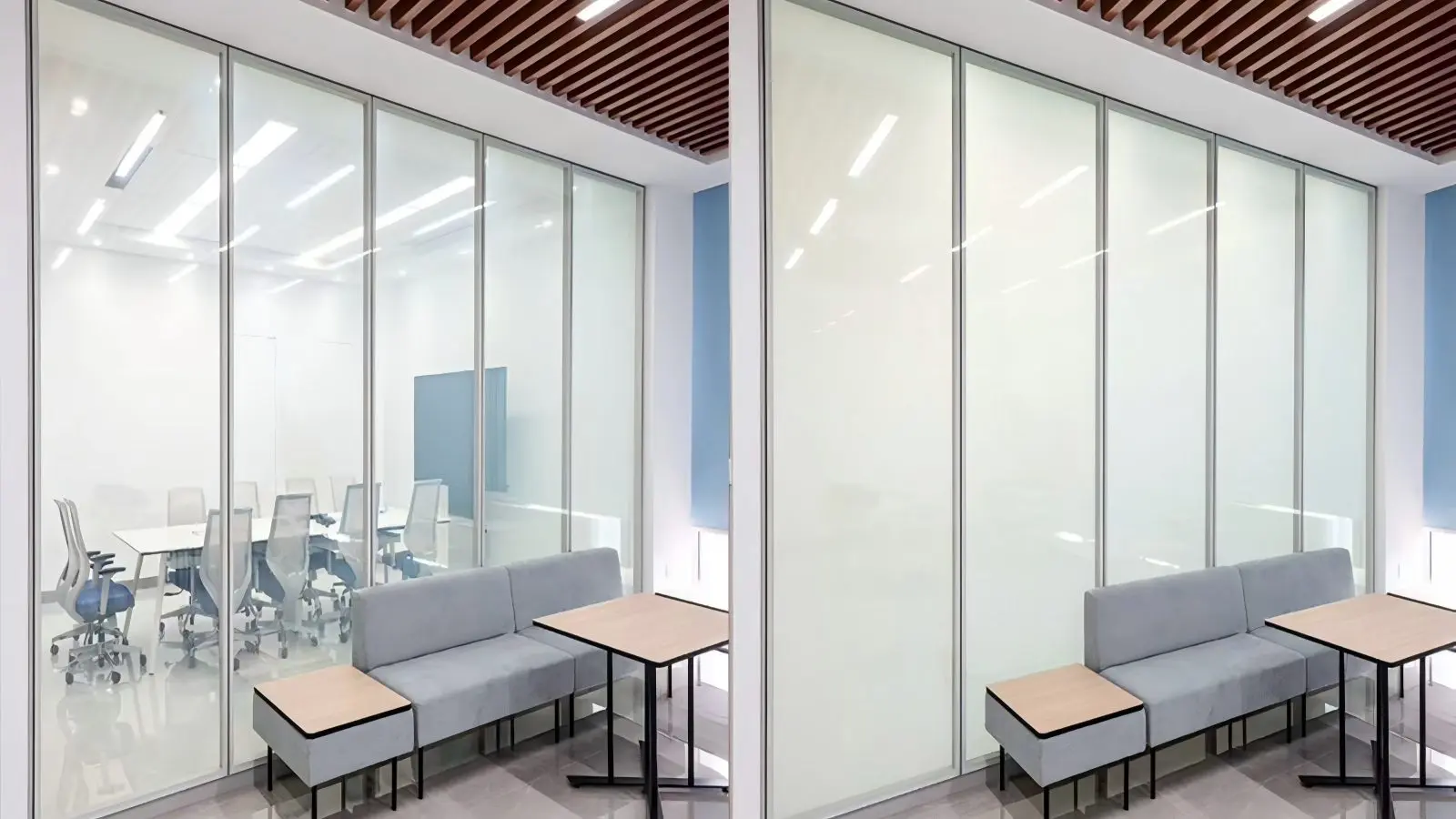
PDLC stands for polymer dispersed liquid crystal. Tiny droplets of liquid crystal are held in a polymer layer between two thin conductive films. With no power, the droplets point in random directions and scatter light, so the glass looks frosted. When voltage is applied, the droplets line up and light passes straight through, so the glass turns clear.
Frosted by default
Our switchable glass works this way: clear when powered, frosted when the power is off. That makes privacy the default state. If the power is cut or a room is left switched off overnight, the glass returns to frosted rather than leaving the room exposed.
Switching speed and power
Our smart glass partition switches from clear to frosted in under one second. Manufacturer data from Gauzy, a PDLC producer, gives an operating voltage of 42 to 70 volts AC and energy use of around 1 to 3 watts per square metre. Low-voltage AC means a transformer or controller sits between the mains and the glass, which is one of the items to plan in Section 6.
Same layer, different protection
The liquid crystal layer is the same in both versions. In the adhesive version it is laminated to a carrier with a self-adhesive back and a protective coating on the face. In laminated smart glass, the same layer is sealed between two panes of glass. Everything else in this guide follows from that one difference.
2. Installation: Retrofit PDLC Film vs New Smart Glass
The first question is not which looks better. It is whether the existing glass is staying.
Adhesive PDLC film
Adhesive PDLC film is applied to glass that is already installed. That makes it the natural choice for a renovation where the partitions are sound and only privacy needs to change. In Gauzy’s comparison of laminated smart glass and adhesive smart film, retrofitting is described as helpful “when glass can’t be replaced or when the glass needs to be thinner than a double pane,” and the film should be applied by professionals. Film can also be cut to custom shapes, which suits bands, logos or partial privacy.
Laminated smart glass
Laminated smart glass is made at the glass factory and installed as new glass. Our switchable glass is produced by sealing the liquid crystal film between two layers of glass under high temperature and pressure. That means it arrives as a finished panel ready to go into the partition frame, with no on-site film application at all.
Cost beyond the price per square metre
Adhesive film is usually the cheaper option per panel, but the comparison should include everything around it. A retrofit still needs an electrician, a power supply for each zone and a route for every cable from the glass edge to the controller, and in an existing office those routes are harder to hide.
New laminated glass carries a higher panel cost, but on a new partition the cable trunking, controllers and glazing are planned together, so less is added on site. Compare the installed cost per room, not the material price alone.
Disruption and programme
Film can be applied with the partition in place, often room by room, which keeps the office working. Replacing glass means removing panes and reglazing, which suits a fit-out that is already under way. If the partitions are being installed new, laminated switchable glass simply replaces the standard panes in the order, with no extra site stage.
Which fits your project
For a new office, or any project where the partition glass is being replaced anyway, laminated smart glass is the simpler route: one product, installed once. For an existing office with good glass, adhesive film avoids replacing panels and reduces disruption. Our guide to office partition film types covers the static decorative and privacy films that sit alongside switchable PDLC film.
3. Durability: Moisture, Edges and Cleaning
The biggest practical difference between the two versions is how well the liquid crystal layer is protected over time.
Why the edges matter
Moisture is the main enemy of the liquid crystal layer. A May 2026 technical article from Solar Screen, a film supplier, notes that “the edges of PDLC film are the most vulnerable area,” that water vapour can diffuse into the polymer layers over time, and that the conductive coatings are sensitive to corrosion. It recommends continuous edge sealing and installing film when ambient humidity is below 60 percent.
In laminated smart glass, the PDLC layer is enclosed between two panes, so the faces are fully protected and only the sealed edge is exposed. Adhesive film has one side bonded to glass and one side open to the room, protected only by its coating, which is why it is more sensitive in humid spaces.
Cleaning
Laminated smart glass is cleaned like ordinary glass on both sides. With adhesive film, one face is the film itself, so cleaning products and methods should be confirmed with the manufacturer, and prolonged water contact should be avoided. In offices with heavy cleaning routines, such as clinics, that is a real maintenance difference.
Lifespan
Manufacturers quote long switching lives for the PDLC layer itself: Gauzy, for example, lists more than 18 million on/off cycles and over 10,000 consecutive hours switched on. Treat these as manufacturer figures. In practice, how long a switchable panel lasts depends more on edge protection, humidity and cleaning than on the liquid crystal, which is why the laminated version is the one recommended where longevity matters most.
4. Safety: What Happens if the Glass Breaks
Office partition glass sits at body height in busy corridors, and glass in and beside doors is a regulated safety glazing location. How each version behaves on impact is worth checking.
Laminated smart glass
Because our switchable glass is laminated, it has the characteristics of safety glass: the interlayer is designed to hold the glass together if it breaks, rather than letting it fall out of the frame. That is the same principle used in laminated safety glass generally.
Adhesive PDLC film
Adhesive PDLC film does not change the safety rating of the glass it is applied to. If the existing partition glass is tempered, it remains tempered glass with a film on it. If it is ordinary annealed glass in a location that needs safety glass, adding a film does not fix that. Confirm the existing glass type before retrofitting, especially next to doors. Our guide to partition door types explains which door locations are treated as safety glazing areas.
5. Size, Frame and Wiring: Fitting PDLC Into a Partition
Switchable glass is still glass in a partition frame, but it has one thing ordinary glass does not: a cable.
Panel widths
Both versions are produced in limited widths. Gauzy lists adhesive film at up to 1.5 metres wide and laminated smart glass at up to 1.8 metres. Our Great Wall and Everest modules run from 400 to 1600 mm wide, so most standard modules sit inside those limits. Wider openings are split into several switchable panels with a mullion between them.
Glass thickness
Laminated smart glass has to fit the partition’s glazing channel. Our Great Wall visible-frame system takes glass from 5 to 12 mm, and our Everest hidden-frame system takes 5 to 8 mm. Confirm the total laminated thickness against the series before the glass is ordered, which is why glass thickness is one of the details we ask for at quotation.
Cable routes
Every switchable panel has a power lead that leaves the glass at one edge. In a modular partition, that cable has to run through the frame to a power supply without being pinched or exposed. Our partition systems offer cable trunking in 105 mm and 178 mm sizes, or custom, and an electrical equipment band, so the route can be built into the frame rather than added on afterwards. Decide which edge each cable exits from at the drawing stage.
Acoustics
Switchable glass changes privacy, not sound. A frosted PDLC panel blocks sight lines, but the acoustic performance is set by the glass build-up and the frame. If a boardroom needs both visual and acoustic privacy, combine switchable glass with the right glazing specification. Our guide to double glazed glass partition acoustics explains the acoustic side.
6. Power and Control: Switching PDLC Film Room by Room
How people switch the glass matters as much as the glass itself.
Control options
Our switchable glass can be controlled by a manual switch, by remote, or through a smart home or building control system. A wall switch by the door suits meeting rooms that change state every hour. A remote suits executive offices. Integration with a building or room booking system suits floors where many rooms switch together, for example frosting all meeting rooms automatically outside working hours.
Power supply
Because the PDLC layer runs on low-voltage AC, each zone needs a transformer or controller sized for the area of glass it drives. Energy use is low, around 1 to 3 watts per square metre on manufacturer data, but the supply still needs a location that is accessible for maintenance and an electrician to connect it. Agree with the electrical contractor early who supplies and wires the controllers.
Zoning
Decide which panels switch together. One switch per room is the usual choice; a long glass wall may be split so part of it stays clear while the rest frosts. Zoning changes the number of controllers and cable runs, so it should be fixed before the glass is ordered.
PDLC Film vs Laminated Smart Glass: Side by Side
| Factor | Adhesive PDLC film | Laminated smart glass |
|---|---|---|
| Best for | Renovations where glass stays | New partitions or glass replacement |
| Installation | Applied to existing glass on site | Installed as new factory-made panels |
| PDLC layer protection | One side bonded to glass, one side coated | Sealed between two panes |
| Cleaning | Confirm method with manufacturer | Like ordinary glass, both sides |
| Humid or wet areas | More sensitive at edges | Better protected |
| Safety glass | Depends on existing glass | Laminated safety glass characteristics |
| Typical max width | 1.5 m (Gauzy data) | 1.8 m (Gauzy data) |
| Cost | Lower | Higher |
| Power-off state | Frosted | Frosted |
For the comparison between switchable glass and static frosted film, see our smart glass partition vs frosted film guide.
Which to Choose, Room by Room
- Boardrooms and executive offices in a new fit-out: laminated smart glass, ideally combined with an acoustic glazing specification.
- Meeting rooms in an existing office with good glass: adhesive PDLC film, switched by a wall switch at the door.
- Clinics and treatment rooms: laminated smart glass, because it cleans like ordinary glass and the PDLC layer is protected from moisture.
- Showrooms and reception walls: either version; film is useful where custom shapes or partial privacy bands are needed.
- Areas near sinks, kitchens or wet cleaning: laminated smart glass, or avoid switchable glass in direct splash zones.
How to Specify PDLC Film or Smart Glass
- State the version: adhesive PDLC film on existing glass, or laminated smart glass as new panels.
- Confirm the glass: for film, the type and thickness of the existing glass; for laminated glass, the total thickness against the partition series.
- Fix the sizes: panel widths and heights, and where wide openings are split into several panels.
- Plan the cables: which edge each lead exits from and how it runs through the frame to the power supply.
- Choose the control: manual switch, remote or building control, and how panels are zoned.
- Check the environment: humidity, cleaning routine and any wet areas near the glass.
Our office glass partition specification checklist covers the rest of the partition package. If you are at the 140th Canton Fair this October, PDLC switchable glass is one of the products on show at our booth.
Frequently Asked Questions
What is PDLC film?
PDLC film is a thin layer of polymer dispersed liquid crystal between two conductive films. With power off it scatters light and looks frosted; with power on it turns clear. It is sold as adhesive film for existing glass or laminated inside new smart glass.
Is PDLC film clear or frosted when the power is off?
Standard PDLC film is frosted when the power is off and clear when it is on. Our switchable glass works this way, so a room returns to privacy if the power is cut.
Can PDLC film be added to existing partition glass?
Yes. Adhesive PDLC film is designed for retrofit onto glass that is staying in place. Check the existing glass type first, plan how the power cable will reach the panel, and have the film applied by professionals in low-humidity conditions.
How long does PDLC film last?
Manufacturers quote millions of switching cycles for the PDLC layer. Real-world life depends mostly on edge protection, humidity and cleaning, which is why laminated smart glass, with the layer sealed between two panes, is recommended where longevity matters.
How much power does PDLC glass use?
Very little. Manufacturer data for PDLC film puts energy use at around 1 to 3 watts per square metre while switched on, at a low AC operating voltage supplied through a transformer or controller.
Does PDLC film make a partition soundproof?
No. PDLC changes visual privacy, not acoustic performance. Sound separation depends on the glass build-up, the frame and the door, so specify acoustics separately.
Get the Right PDLC Film or Smart Glass for Your Rooms
Deciding between retrofit film and new switchable glass? Send us your floor plan with your preferred glass thickness and control system, whether manual, remote or smart home, and we will recommend PDLC film or laminated smart glass for each room and show how it fits your partition system.