Office Partition Film: 5 Proven Types (Switchable PDLC)

An office partition film transforms a plain glass partition into a privacy screen, brand feature, or on-demand switchable surface — without replacing the partition itself. Selecting the right film type depends on whether the privacy need is permanent or switchable, whether the film carries brand identity, and whether the underlying glass needs security upgrades. This guide walks through the five proven office partition film types, based on installations coordinated with 3M Fasara, Solar Gard, and PDLC smart film manufacturers across commercial office projects.
Why Office Partition Film Selection Matters
An office partition film works with the underlying glass partition — it doesn’t replace the partition system. Selecting the right office partition film type depends on four specific questions: is privacy needed permanently or on-demand, does the wall need to carry brand identity, is security a concern, and what’s the expected lifespan of the specific privacy or brand strategy.
Film vs alternative privacy approaches
Before committing to film, verify that film is the right approach:
- Fully opaque wall needed permanently — Consider solid partition wall or paint glass partition (permanent, better finish quality) instead of film
- On-demand transparent/opaque switching — Compare film alternatives (Type 4 PDLC) against dedicated smart glass systems in our smart glass vs frosted film analysis
- Custom brand color throughout — Back-painted glass typically outperforms film on both cost and lifespan (see paint glass partition guide)
- Standard privacy with pattern flexibility — Film is the right approach, and Types 1-3 below cover the range
Where office partition film outperforms alternatives
Film approaches deliver three specific advantages over permanent glass finish alternatives: lower initial cost (typically 50-70% less than back-painted or ceramic-frit alternatives), reversibility (removable when brand strategy or privacy needs change), and pattern flexibility (custom graphics can be printed on film that can’t be produced in back-painting or ceramic frit). These advantages make office partition film the default privacy approach for spaces where the specific privacy or brand treatment is expected to change within 5-10 years.
Type 1: Frosted Privacy Film
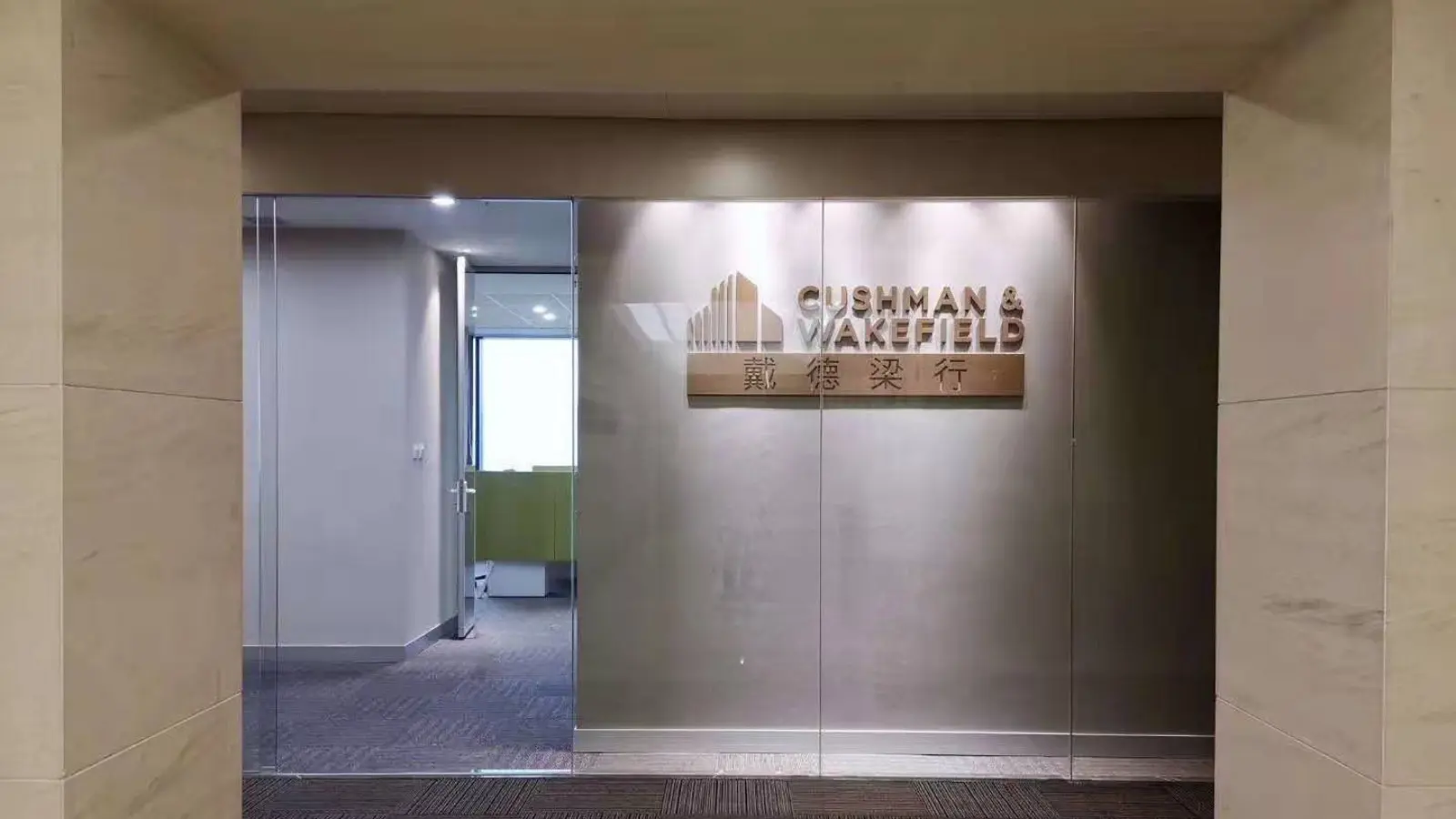
Frosted privacy film is the volume default for office partition film specifications. Vinyl film applied to the room-side glass surface produces a permanently translucent finish that blocks sight lines while transmitting daylight. The film is available in multiple opacity levels (50% translucent through 95% opaque) and multiple visual textures (uniform frosted, gradient, dot pattern).
Standard specifications
- Material — Cast or calendered vinyl film with adhesive backing · 0.075mm-0.12mm thickness typical
- Manufacturer tier — 3M Fasara architectural films or comparable specification (Solar Gard, Avery Dennison)
- Coverage — Full panel or specific privacy band (e.g., 900mm-1800mm height band for standing privacy at meeting rooms)
- Installation — Applied to glass during fit-out or as post-install upgrade; 2-3 hours per typical partition panel
- Cost — $25-60 per square meter installed depending on film tier and coverage complexity
- Lifespan — 5-7 years before edges peel and slight yellowing becomes visible
Typical applications
Frosted privacy film works well for: private office corridor-facing walls where standing-height privacy matters, meeting room walls where in-session confidentiality is needed but permanent solid wall is over-specification, restroom entry areas where daylight-transmitting privacy is preferred over solid wall, and any wall where the privacy need is permanent but the exact partition system may change within 10 years.
Product reference
For 3M Fasara architectural film specifications, see 3M Fasara product page. Comparable specifications available from Solar Gard, Avery Dennison, and other architectural film manufacturers.
Type 2: Decorative Pattern Film
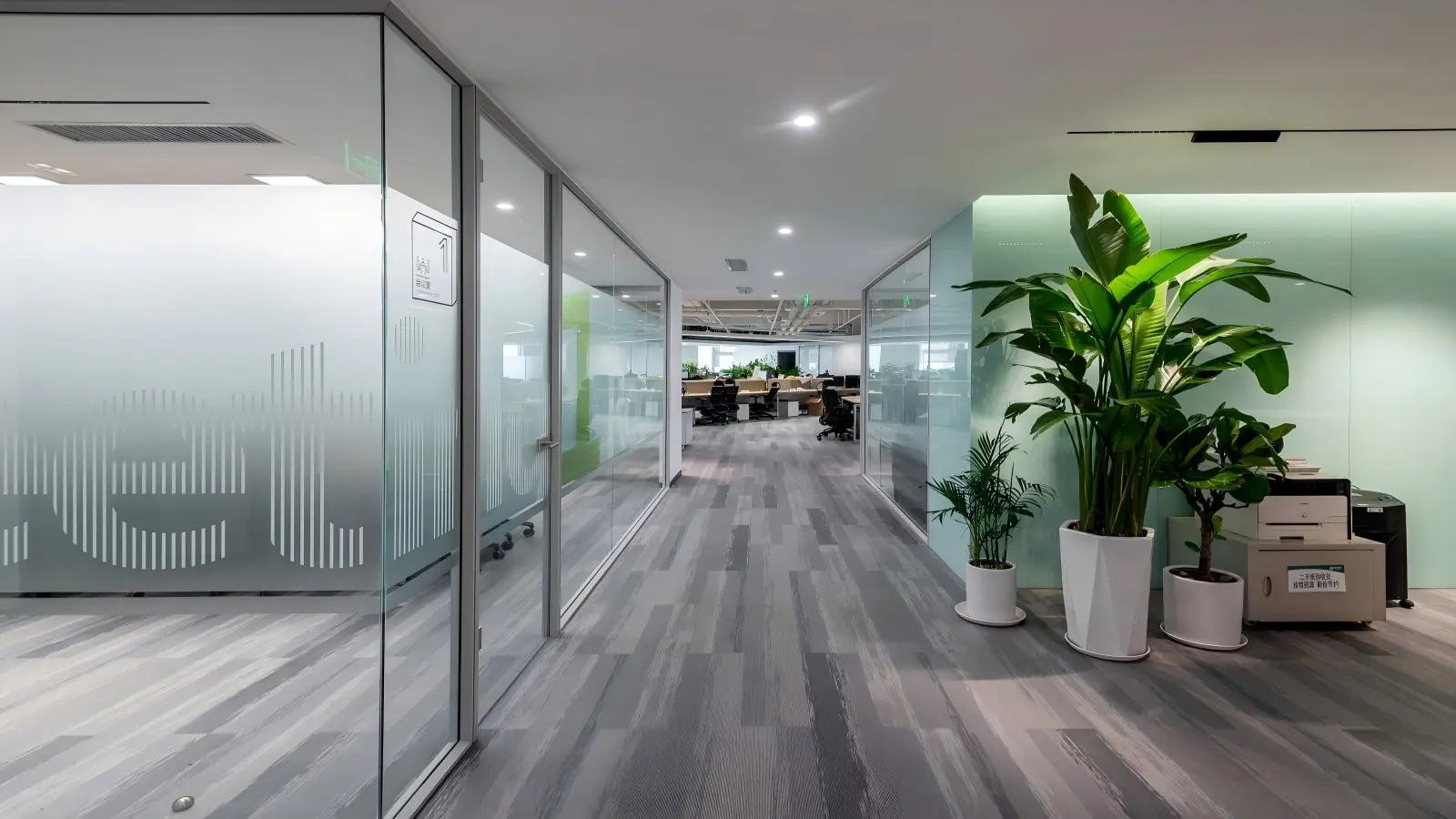
Decorative pattern film extends the basic frosted film category with visual pattern content: geometric shapes, linework, natural motifs (leaves, wood grain), or abstract patterns. The pattern serves dual function — provides privacy at the frosted portions while creating architectural detail at the pattern edges.
Standard specifications
- Pattern types — Geometric (dot, line, grid), natural (leaf, branch, botanical), abstract (waveform, gradient), or custom-designed patterns
- Coverage strategy — Full panel with pattern, banded pattern with clear reveal above/below, or edge-only pattern with clear central panel
- Manufacturer — 3M Fasara (extensive standard pattern library), Solar Gard, or specialty architectural film manufacturers for custom patterns
- Cost — $40-90 per square meter installed depending on pattern complexity
- Lifespan — 5-7 years matching standard frosted film
Typical applications
Decorative pattern film works well for: corridors where visual variety supports wayfinding, meeting room walls where the pattern adds design interest without demanding brand statement, and reception areas where the pattern coordinates with broader interior design without requiring custom brand graphics.
Pattern coordination
Decorative pattern film should coordinate with the broader office design vocabulary — the pattern selected for a modern tech office differs from the pattern appropriate for a traditional legal or financial services office. See our legal office design guide and executive office design guide for the design vocabulary framework that pattern selection should coordinate with.
Type 3: Brand Graphics and Wayfinding Film
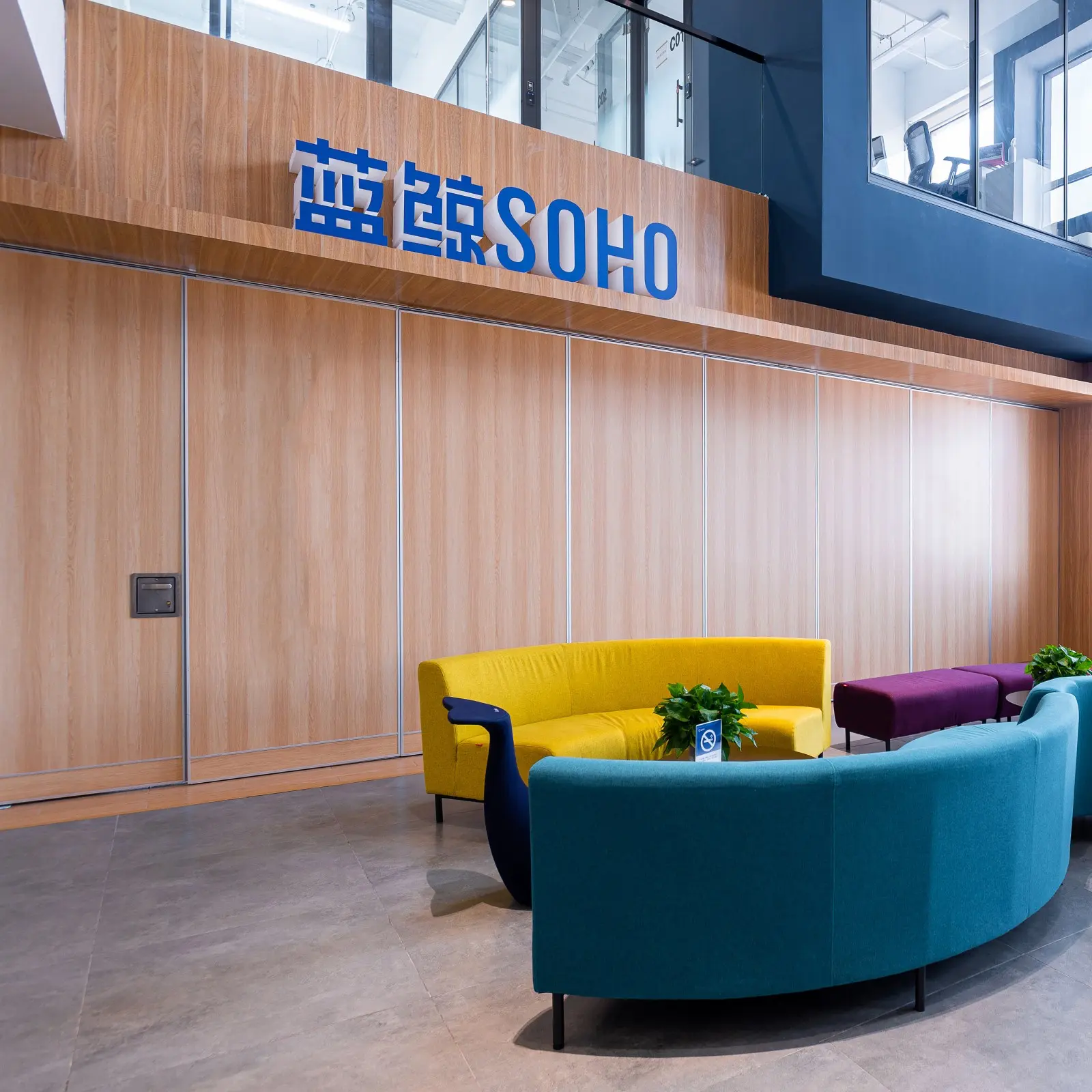
Brand graphics film applies corporate identity content — logos, tagline text, wayfinding graphics, brand color fields — to partition glass as printed film. This is the film type that most directly serves visible brand strategy, and it’s most commonly specified at reception, main corridor feature walls, and boardroom entry points.
Standard specifications
- Printing method — Digital UV printing (photographic-quality graphics), screen printing (large-run graphics), cut vinyl (simple logo shapes and text)
- Color capability — Full CMYK color range with digital UV; limited color palette for screen printing
- Coverage — Logo-only (small footprint on clear glass), banded graphics with logo integration, or full-panel graphic wallpaper effect
- Cost — $60-200 per square meter depending on graphic complexity and print method
- Lifespan — 3-5 years for interior applications before color fading becomes visible (shorter than plain frosted film because pigmented films fade faster than translucent films)
Coordination with print production
Brand graphics film specification requires coordinated print production: high-resolution artwork files (typically 300 DPI minimum at final size), color profile matching (Pantone or brand color specification), and proofing sample approval before full production run. Budget 2-3 weeks additional lead time for print coordination on top of standard fit-out schedule.
Alternative: back-painted brand color
For solid brand color fields (as opposed to graphic content), back-painted glass typically outperforms printed film on both cost per square meter and lifespan. See our paint glass partition guide for the color category strategies where paint glass is the better specification than film. Film is the better choice specifically for content that requires printing (logos, graphics, wayfinding text); paint glass is the better choice for solid brand color fields.
Type 4: Smart Switchable Film (PDLC)
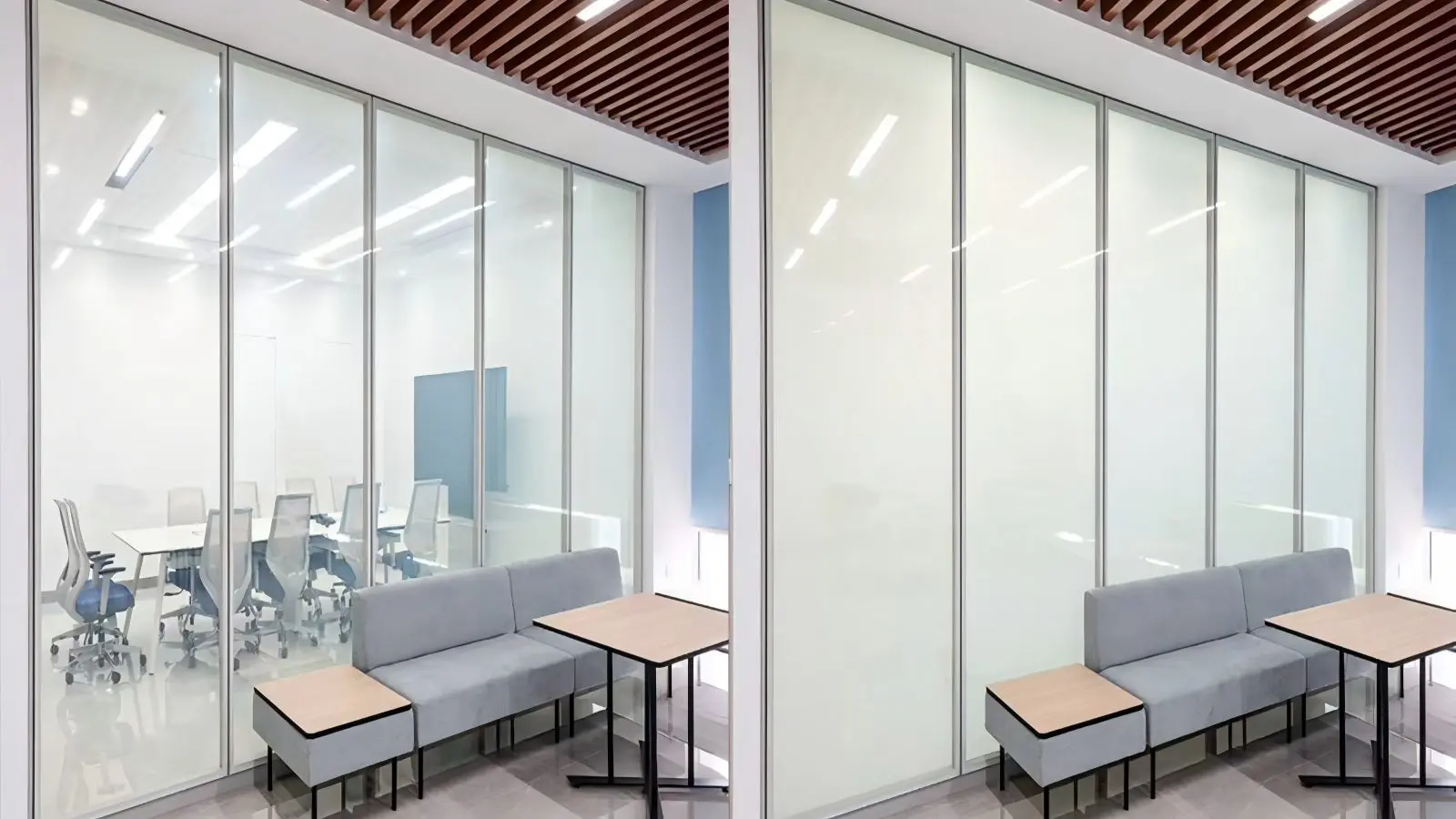
Smart switchable film represents the highest-technology office partition film category. PDLC (Polymer-Dispersed Liquid Crystal) film is laminated between two glass layers during factory manufacture. Applied voltage aligns the liquid crystal molecules, making the film transparent. Voltage removed, the molecules randomize and the film returns to opaque-frosted state. Switching happens in under one second.
Standard specifications
- Film construction — PDLC film sandwiched between two glass layers (typically 5mm+PDLC+5mm total assembly)
- Electrical requirement — 24V or 48V DC power supply · low power consumption (typically 5-10W per square meter during transparent state, zero when opaque)
- Switching speed — Under 1 second between clear and opaque states
- Control options — Manual switch, motion sensor, occupancy sensor, smart building automation integration
- Cost — $400-700 per square meter installed (10-15× standard frosted film cost)
- Lifespan — 15-20 years matched to the partition (not the surface-applied film lifecycle of 5-7 years)
Critical distinction from surface-applied film
Smart PDLC film is fundamentally different from surface-applied films (Types 1-3). PDLC is integrated between glass layers at factory manufacture — it can’t be applied to existing glass, and it can’t be removed if the specification changes. Surface-applied films (frosted, decorative, brand graphics) apply to existing glass and can be removed or replaced. This distinction affects both initial specification (retrofit possible for surface films, factory-only for smart film) and end-of-life (smart glass panels are typically replaced as complete units).
Typical applications
Smart switchable film works well for executive offices needing on-demand privacy toggling, boardrooms hosting confidential discussions with transparent-clear normal state, and premium meeting rooms where the switching capability itself is a feature. See our detailed cost-benefit analysis in our smart glass vs frosted film comparison and the executive office application context in our executive office design guide.
Type 5: Security and Anti-Shatter Film
Security film addresses a different specification need than the privacy-focused Types 1-4. Anti-shatter film applied to partition glass increases the glass’s resistance to breakage and, if broken, holds the fragments together. Common applications include ground-floor partitions where vandalism risk exists, high-traffic corridors where accidental impact damage is a concern, and applications where security or safety code requires enhanced glass performance.
Standard specifications
- Film thickness — 100 micron (4 mil) for basic security, 200 micron (8 mil) for enhanced security, 300+ micron for forced-entry resistance
- Manufacturer tier — 3M safety and security window films, Solar Gard, comparable specifications from other manufacturers
- Optical characteristics — Optically clear (doesn’t affect glass transparency) but slight reduction in light transmission (typically 5-10%)
- Installation — Applied to interior-facing glass surface during fit-out or post-install; wet installation method for larger panels
- Cost — $30-80 per square meter installed depending on film thickness
- Lifespan — 10-15 years for interior applications
Coordination with fire ratings
Security film application to fire-rated glass may affect the fire rating certification — verify with the rating manufacturer before specification. Some fire-rated glass assemblies specifically prohibit surface film application because it can trap heat and cause premature glass failure during fire test conditions. See our fire rated glass partition guide for the rating context.
Combining security film with privacy film
Security film can be layered with frosted or decorative privacy film for combined security-plus-privacy performance. Typical layer order: security film applied to interior-facing glass surface, privacy film applied over the security film. The combination adds 30-40% to cost versus either film alone but delivers both security and privacy in a single specification.
Selection Matrix and Cost Comparison
Use this matrix to identify the office partition film type that matches specific project needs:
| Need | Film Type | Cost (per m²) | Lifespan |
|---|---|---|---|
| Permanent privacy, standard finish | Type 1: Frosted privacy | $25-60 | 5-7 years |
| Permanent privacy with visual interest | Type 2: Decorative pattern | $40-90 | 5-7 years |
| Brand identity or wayfinding content | Type 3: Brand graphics | $60-200 | 3-5 years |
| On-demand privacy switching | Type 4: Smart PDLC | $400-700 | 15-20 years |
| Impact / security enhancement | Type 5: Security | $30-80 | 10-15 years |
Coordination with underlying partition system
Office partition film specification should coordinate with the underlying partition system decisions covered in our broader partition guides. See our Great Wall vs Everest comparison for the base partition system framework, our commercial solid partitions specifications guide for the specification decision framework, and our installation guide for the coordination sequencing between partition install and office partition film application.
Frequently Asked Questions
Can office partition film be applied to existing glass, or does it require new glass?
Surface-applied office partition films (Types 1, 2, 3, and 5 covered in this guide) can be applied to existing glass partitions without requiring glass replacement. Installation typically takes 2-3 hours per standard partition panel and can happen during business operations with minimal disruption. Smart switchable PDLC film (Type 4) is fundamentally different — it’s laminated between glass layers at factory manufacture and cannot be applied to existing glass.
Specifying smart switchable capability requires ordering new glass partition assemblies with the PDLC film integrated during manufacture. This is one of the primary economic decisions in office partition film specification: retrofit-capable films (Types 1-3, 5) work with existing installations; smart PDLC (Type 4) requires new partition specification.
How long does office partition film typically last before needing replacement?
Standard frosted and decorative office partition films (Types 1 and 2) typically last 5-7 years in interior applications before edge peeling, adhesive discoloration, or slight yellowing becomes visible enough to prompt replacement. Brand graphics film with printed content (Type 3) has a shorter lifespan of 3-5 years because printed pigments fade faster than translucent films. Security film (Type 5) lasts 10-15 years because the film construction is thicker and more UV-resistant.
Smart PDLC film (Type 4) lasts 15-20 years because it’s integrated between glass layers rather than surface-applied — the film is protected from cleaning chemicals, UV exposure, and physical wear that degrades surface films. When film replacement time comes, plan for careful removal of old adhesive residue (typically 2-3 hours per panel for professional removal) before applying replacement film.
What’s the cost difference between office partition film and painted or frosted glass?
Static frosted film costs approximately $25-60 per square meter installed — significantly less than back-painted glass ($150-250 per square meter) or factory-frosted glass ($80-150 per square meter premium over clear glass). The cost difference makes office partition film the volume default for privacy applications where the specific privacy treatment might change within 5-10 years.
However, lifespan differences narrow the total cost comparison: film requires replacement every 5-7 years, while painted or factory-frosted glass typically lasts the life of the partition (15-20+ years). Over a 15-year facility lifecycle, the cost comparison becomes: 2-3 film replacement cycles ($75-180 per square meter total) versus one-time painted or frosted glass installation ($150-250 per square meter). Film wins on flexibility and initial cost; painted or frosted glass wins on total cost of ownership for stable long-term privacy strategy.
Can I combine multiple office partition film types on the same partition?
Yes — several combinations work well for specific applications. Security film (Type 5) plus frosted privacy film (Type 1) delivers both impact resistance and privacy in one specification, typical for ground-floor partitions or high-security applications. Brand graphics film (Type 3) plus frosted privacy film (Type 1) works when the wall needs both permanent privacy and brand identity content, typically at reception feature walls. Decorative pattern film (Type 2) plus wayfinding graphics (subset of Type 3) works in corridors where visual interest and navigation support both matter.
Combinations add approximately 30-40% to the cost of either individual film alone. Smart PDLC film (Type 4) cannot be combined with surface-applied films because Type 4 is between-glass integrated rather than surface-applied. All office partition film combinations should coordinate with the underlying partition system decisions covered in our commercial solid partitions specifications guide.
Does office partition film affect the acoustic performance of the partition?
Surface-applied films (Types 1, 2, 3, 5) have minimal effect on partition acoustic performance — the film adds less than 0.5 dB to Rw acoustic rating in typical thickness ranges. Acoustic performance is primarily determined by the underlying partition assembly (glass thickness, frame construction, edge sealing, door specification) rather than the film.
Smart PDLC film (Type 4) similarly has minimal acoustic effect because the film is a thin layer within the glass laminate rather than a bulk material affecting sound transmission. For applications where acoustic performance matters (executive offices, meeting rooms, healthcare consultation rooms), specify the acoustic performance at the partition system level using the frameworks in our acoustic privacy guide, and treat office partition film selection as an independent decision that doesn’t affect acoustic specification.
How do I coordinate office partition film with the base partition specification?
Coordinate office partition film specification at partition design phase rather than as an afterthought. Three coordination points matter most: first, decide whether smart PDLC (Type 4) is in scope — if yes, the partition must be ordered with integrated smart glass rather than standard glass. Second, plan the film installation sequence relative to partition install — surface films can be applied before or after partition install, but pre-install application in the manufacturing facility typically produces better edge alignment.
Third, coordinate the film pattern or graphic layout with the partition mullion grid — patterns and graphics that ignore the mullion positions can produce visual conflicts (pattern lines that don’t align with structural elements). See our installation guide for the partition install sequencing that film application coordinates with, and coordinate all office partition film decisions with the general partition specification framework in the commercial solid partitions specifications guide.
Specifying Office Partition Film for Your Project
The five standard office partition film types covered in this guide — frosted privacy, decorative pattern, brand graphics, smart switchable, security — cover 95% of commercial office film applications. Getting the right office partition film type at design phase (matched to permanent vs on-demand privacy needs, brand strategy, and expected lifespan) prevents the specification revisions that late-stage film decisions typically require.
To explore product configurations that coordinate with office partition film specification, visit our complete partition product range, review the smart glass vs frosted film analysis for the detailed switchable-vs-static decision, or see the alternative permanent finish approaches in our paint glass partition guide. For the underlying partition system decisions that film specification coordinates with, start with our Great Wall vs Everest comparison.