
Glass Partition with Blinds: 7 Proven Rules, Best Privacy
A glass partition with blinds gives a room two modes: open and bright, or private. Seven rules for specifying built-in blinds well, from integrated vs surface blinds to panel sizes, controls, hygiene, acoustics and service.

A glass partition with blinds gives a room two modes: open and bright when the blinds are up, private when they are down. That flexibility is why built-in blinds remain one of the most requested options on office glass walls. This guide sets out 7 proven rules for specifying them well, from choosing integrated or surface blinds to panel sizes, controls, hygiene and what blinds can and cannot do for sound.
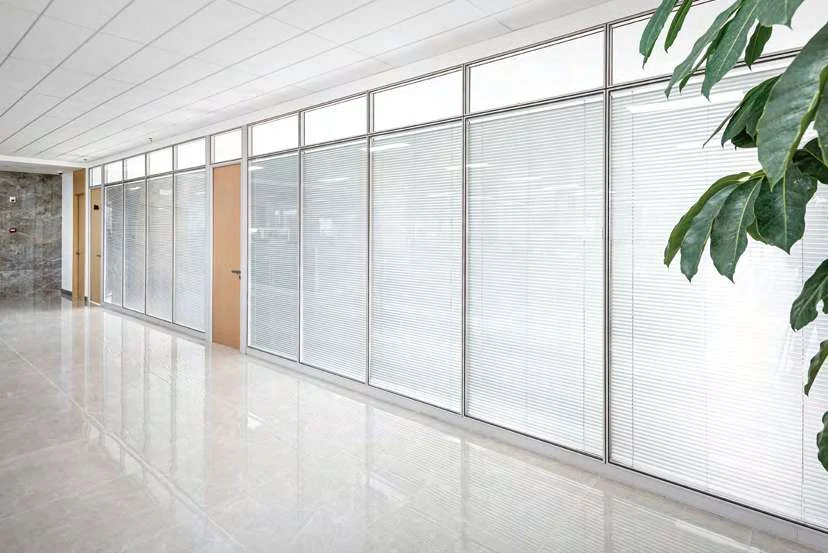
Rule 1: Choose Integrated or Surface-Mounted Blinds
The first decision for any glass partition with blinds is where the blind sits. The two options look similar on a sales drawing and behave very differently in use.
Integrated blinds
An integrated blind sits inside a double-glazed module, in the cavity between the two panes. It is protected on both sides by glass, so it cannot be bent, pulled or knocked, and dust cannot settle on the slats. This is the version most people mean when they ask for a glass partition with blinds in a new office.
Surface-mounted blinds
A surface-mounted blind is fixed to one face of the glass or frame, the way a window blind is fitted to a window. It is cheaper, works on single glazing and can be added to an existing wall. It is also exposed to dust, handling and cords, and it sits on one side of the wall only, so only one room controls it.
Mixing both on one project
Many offices use both. New meeting rooms and private offices get integrated blinds, while an existing glass wall that is staying put gets a surface blind or film. Keeping the blind colour and slat width similar across the two makes the mix far less noticeable from the corridor.
Which to choose
For new fit-outs, integrated blinds are usually the better long-term choice. Surface-mounted blinds suit retrofits where the existing partitions stay, or where the budget only covers single glazing. Our partition film guide covers another retrofit route: adding privacy with film instead of blinds.
Rule 2: Understand How Integrated Blinds Are Built
A glass partition with blinds built in is a double-glazed module with one extra component in the cavity. Knowing how that module is put together explains most of its strengths and limits.
The double-glazed module
Both of our modular systems offer double glass louver versions. On the Great Wall series, the double-glass module spacing is 47 mm, and the louver version uses two layers of 5 mm tempered glass with a venetian blind fitted inside. On the Everest series, the double-glass spacing is 64 mm, the frame is hidden, and the glass is paint-treated on all four edges, so the blinds read as part of a continuous glass plane.
How the blind works
In our glass partition with blinds, the blind is a venetian type whose slats tilt. Turned open, the room stays visible and daylight passes through; turned closed, the room becomes private. In the words of our catalogue, privacy and permeability can be switched at any time.
Made in-house
For every glass partition with blinds we supply, our Shenyang factory runs its own louver production line alongside glass processing and aluminium profile processing, so blind, glass and frame are produced and assembled as one module rather than sourced separately.
Rule 3: Plan the Layout Around Louvered Panel Sizes
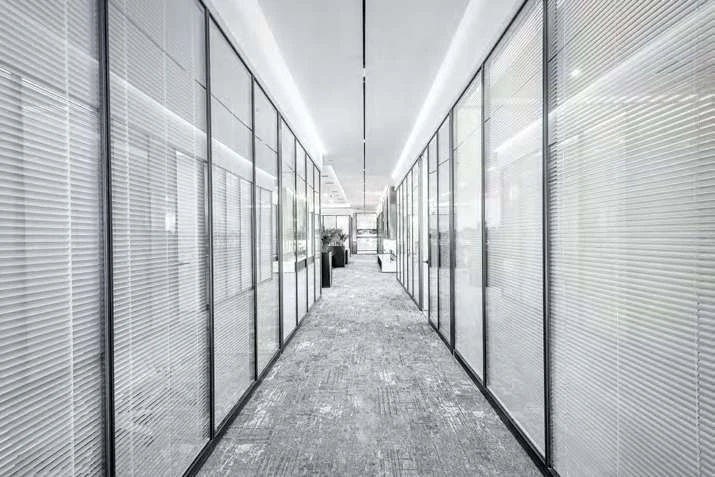
A glass partition with blinds does not use quite the same module sizes as a plain glass wall, and the layout should be drawn with that in mind from the start.
Our recommended limits
Our standard modules run from 1200 to 3600 mm high and 400 to 1600 mm wide. For louvered panels, we recommend not exceeding 1250 mm in width or 3000 mm in height. Larger blinds are heavier and less stable in the cavity, so wider bays in a glass partition with blinds are better split into two modules.
What that means for the drawing
- Rooms with ceilings above 3000 mm may need a transom or a fixed upper panel above the louvered module.
- Long runs will have more vertical joints than a plain glass wall of the same length.
- Doors, cable management modules and louvered panels should be set out together, so joints line up.
Our glass partition installation guide explains how these module sizes are fixed at survey and shop-drawing stage, before production.
Rule 4: Pick the Control Before the Finish
The control is the part of a glass partition with blinds that people touch every day, and the part that decides how long the blind keeps working.
Control types on the market
A continuing-education course sponsored by a built-in blind maker, Built-In Blinds (BNP Media, 2019), describes the main operators: a manual knob, a manual sliding magnetic handle, a cord-operated external magnetic device, battery or solar motorised controls, and internal motors in the head rail. Pilkington describes a magnet control on its sealed-blind units that does not compromise the unit seal.
Questions to ask
- Does the blind tilt only, or also raise and lower?
- Which side of the wall is the control on, and can both rooms reach it?
- Are there loose parts, such as a removable handle, that could go missing?
- For motorised versions, how are power and replacement batteries handled?
The same course notes one project owner who chose a knob control precisely because they did not want parts that could be removed or lost. In shared offices, a simple fixed control is often the most durable answer.
Rule 5: Count on Blinds for Sight, Not Sound
Closing the blinds makes a room look private. It does not make it quieter. This is the most common misunderstanding about a glass partition with blinds.
Where sound insulation comes from
In a glass partition with blinds, sound insulation comes from the glass, the cavity, the seals and the door. Our catalogue lists 30 dB of partition sound insulation for the Great Wall series and 45 dB for the Everest series, and a louvered module is built on the same double-glazed construction. Our double glazed partition guide explains how glass, cavity and seals add up.
Blinds and lighting
Visual privacy also depends on light. With the slats tilted part-way, a brightly lit room can still be seen into from a darker corridor, especially in the evening. Where a room must be fully private after dark, close the blinds fully or combine the glass partition with blinds with a frosted band at eye level.
The door decides the room
A well-insulated wall with an unsealed door behaves like the gap under the door. If the room needs confidential conversations, specify door seals with the same care as the blinds. Our partition door types guide compares the options.
Rule 6: Use Sealed Blinds Where Cleaning Matters
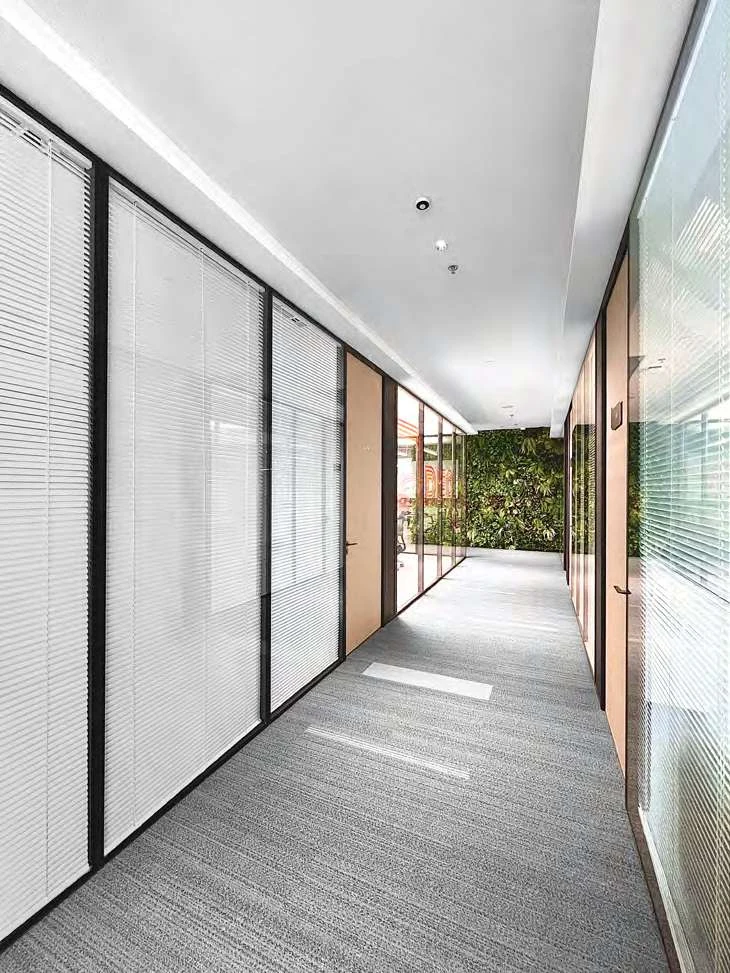
Blinds collect dust. In most offices that is a housekeeping job; in clinics, laboratories and food businesses it is a hygiene question, and it is where a sealed glass partition with blinds earns its place.
What the guidance asks of blinds
The CDC’s environmental infection control guidelines recommend cleaning walls, blinds and window curtains in patient-care areas when they are visibly dusty or soiled. Exposed blinds therefore join the cleaning schedule, while a sealed glass partition with blinds keeps the slats out of reach of dust.
What sealing changes
The BNP Media course notes that blinds encased in glass do not collect dust, mould or bacteria, which it gives as a reason they are commonly chosen in health care. Pilkington makes a similar claim for its sealed units and lists hospitals and nursing homes among typical uses. For healthcare layouts, see our guides to clinic glass partitions and dental clinic partition design.
Rule 7: Plan for Service Before You Need It
The strength of an integrated glass partition with blinds is also its limit: the blind is sealed in, so it cannot be reached for a quick repair.
What to agree with the supplier
- The warranty on the blind mechanism, separately from the glass and frame.
- How a faulty module is replaced, and how long a replacement takes to produce and ship.
- Whether a small number of spare modules should be ordered with the project.
The BNP Media course makes the same point from the other side: because the blinds sit inside a sealed unit, manufacturer support and warranties matter if a mechanism fails, and lead times should be planned for.
Why modular construction helps
On a demountable glass partition with blinds, a louvered module can be removed and replaced without rebuilding the wall around it. Our modular range is designed for a 95% material reuse rate, and our demountable wall system guide explains how modules come apart.
Glass Partition with Blinds, Film or Smart Glass?
A glass partition with blinds is one of three common ways to add privacy to glass. Each suits a different pattern of use.
| Option | Privacy control | Light when private | Cleaning | Best for |
|---|---|---|---|---|
| Integrated blinds | Adjustable by hand, from open to closed | Partial, through tilted slats | Sealed, no blind cleaning | Offices, meeting rooms, clinics |
| Surface-mounted blinds | Adjustable, one side only | Partial | Exposed, needs cleaning | Retrofits, single glazing |
| Frosted or decorative film | Fixed | Diffused | Wipe clean | Constant privacy at eye level |
| Smart glass | Switch, clear to frosted in under one second | Diffused | Wipe clean | Rooms used in two modes |
A smart glass partition gives instant privacy at the press of a switch, while blinds give graded control and cost less to run. Our comparison of smart glass vs frosted film covers the other two options in more detail.
Glass Partition with Blinds by Room
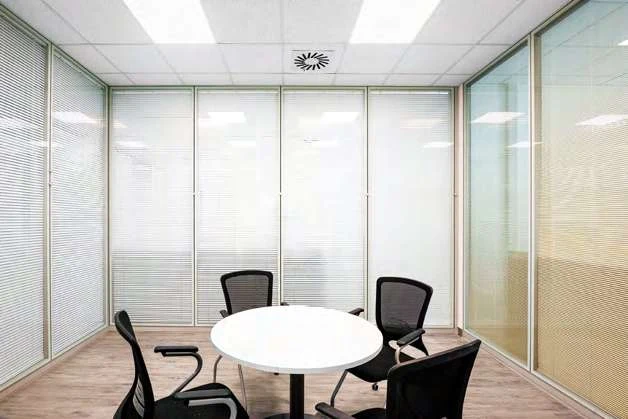
- Meeting rooms. The classic use: open between meetings, closed for presentations or confidential discussions.
- Private offices. The occupant decides how visible they want to be through the day.
- HR and interview rooms. Privacy on demand, combined with double glazing and a sealed door for sound.
- Clinics. Sealed blinds remove one item from the cleaning list.
- Corridors. Usually left open; blinds on the room side let each team set its own privacy.
If you are choosing between the two systems, our Great Wall vs Everest comparison sets out the differences in frame, glass and appearance. Our specification checklist lists what else to include when you request a quote for a glass partition with blinds.
What to Send When Ordering a Glass Partition with Blinds
A quote for a glass partition with blinds is only as accurate as the brief behind it. Include these with your enquiry:
- A floor plan marking which rooms need blinds and which can stay clear.
- Ceiling heights, so modules above 3000 mm can be planned with a transom or fixed upper panel.
- The system you prefer: visible-frame Great Wall or hidden-frame Everest.
- Which side of each wall the blind control should face.
- Door positions, door types and any acoustic requirements.
- Frame colour: RAL 7047, RAL 7016 or fluorocarbon grey as standard.
Common Mistakes with a Glass Partition with Blinds
- Drawing bays wider than the blind allows. The layout has to be redrawn with extra joints.
- Expecting closed blinds to stop sound. Blinds manage sight; glass, seals and doors manage sound.
- Putting every control on the corridor side. The people inside the room cannot adjust their own privacy.
- Choosing surface blinds for clinical rooms. Exposed slats join the cleaning schedule.
- Ignoring the service plan. A sealed blind is replaced as a module, so agree warranty and spares up front.
Frequently Asked Questions
Do glass partitions with integrated blinds need cleaning?
The glass faces need normal cleaning. The blinds themselves are sealed inside the double-glazed module, so dust does not settle on the slats. That is the main reason integrated blinds are chosen over surface-mounted ones in offices and clinics.
How big can a louvered panel be?
On our systems we recommend louvered panels no wider than 1250 mm and no taller than 3000 mm. Standard plain modules can go up to 1600 mm wide and 3600 mm high, so tall rooms may need a fixed panel or transom above the louvered module.
Which system is better for a glass partition with blinds?
Both work. Great Wall gives a visible aluminium frame, a 47 mm double-glass cavity and the widest glass range. Everest gives a hidden frame, a 64 mm cavity and a higher published sound insulation figure of 45 dB. Choose on appearance and acoustic need; the blind options follow the system.
Do blinds improve sound insulation?
No. Blinds control visibility, not sound. Sound insulation comes from the double glazing, seals and door. Our catalogue lists 30 dB for the Great Wall series and 45 dB for the Everest series.
Can blinds be added to an existing glass partition?
Integrated blinds need a double-glazed module, so they are normally specified at the start of a project. For an existing single-glazed wall, surface-mounted blinds, film or retrofit smart film are the usual options.
What happens if an integrated blind stops working?
Because the blind is sealed in, the module is replaced rather than repaired on site. On a modular system that is a module swap, not a wall rebuild. Agree the warranty and replacement process with the supplier before ordering.
Planning a Glass Partition with Blinds?
Send us your floor plan with the rooms that need privacy marked, your ceiling height and any acoustic requirements. Our engineering team will set out the louvered modules, doors and glass for each room, within the panel limits that keep the blinds working.